Contents
Scroll to:
https://doi.org/10.23947/2414-1143-2026-12-2-63-68
Scroll to:
Introduction. Since their inception, large-scale festive events have served as a highly effective means of public communication. It is customary to associate the concept of a festival with cultural leisure, rest, and entertainment. However, the entertainment function is not only not the sole purpose of organizing a festive event, but also not its primary one. Throughout the history of this social phenomenon, its primary mission has been ideological propaganda. The essence of the ideology being promoted could be based on religious, political, social, moral, or artistic doctrines. But in any case, the proposed idea only penetrated the consciousness of the masses when it was presented in a systematic, understandable, and appealing manner. In other words, the ideological content conveyed through festive activities becomes effective only if it is visualized in an expressive and convincing way.
Materials and Methods. The primary method employed was bibliographic research, based on the examination of archival materials and their interpretation by contemporary scholars. The most significant contribution to the study of this issue came from the works of A.I. Piotrovsky, a Soviet literary scholar, playwright, and theater critic. The achievement of the stated goal was also based on a comparative analysis of the artistic and compositional techniques used in the design of the first revolutionary celebrations within the context of academic, Futurist, and Constructivist approaches.
Results. This paper examines various methods used to visualize the propaganda and agitation policies of the young Soviet state, which sought to foster a positive attitude among the masses toward the new ideology through vividly staged festive events. Amid economic ruin and fierce political confrontation with the enemies of the Soviet system, the government allocated considerable financial and human resources to organizing these celebrations. These spectacular events were intended to bring a sense of joy and optimism, as well as faith in the superiority of the new state system, into the difficult lives of Soviet Russia’s citizens. To this end, the best artists, architects, and designers were enlisted to design the celebrations.
Discussion and Conclusion. The experience of using artistic and expressive approaches to shaping the visual space of a holiday has enriched exhibition design with a rich arsenal of tools for visually conveying ideological content. Many techniques for creating a festive atmosphere in an urban setting are successfully applied in the present day as well. An important factor in the development of artists’ exhibition activities in festival design was the involvement of students from design universities in fulfilling government commissions. Exceeding expectations, the synergy of experience and innovative creative thinking ensured the effective achievement of objectives while using minimal material resources.
Berdnik T.O., Komaristaia Yu.S. The Political and Aesthetic Context of Revolutionary Celebrations in Soviet Russia. Science Almanac of Black Sea Region Countries. 2026;12(2):63-68. https://doi.org/10.23947/2414-1143-2026-12-2-63-68
Introduction. In the 1920s, following the upheavals of the revolution and the civil war, the young Soviet state needed to take proactive steps aimed at establishing a positive image and the authority of the new political system. This mission was largely entrusted to festive events capable of lifting the spirits of society and preparing its consciousness to embrace new values [1]. Consequently, in a country undergoing economic and social upheaval, the number of mass holidays and uplifting celebrations of various kinds was multiplied: sports, military-patriotic, socio-political, artistic-cultural ones, and so on.
Even as severe austerity measures were imposed in other areas of public life, substantial funds were allocated to holiday decorations, and the most talented and progressive artists were enlisted. During the preparation and celebration of these events, the architectural landscape of Soviet cities underwent a fundamental transformation. Buildings, streets, parks, and public transportation were all decorated. Urban installations visualizing the holiday’s core ideological concept were erected everywhere [2].
Materials and Methods. The primary method used to build knowledge on the subject under study was bibliographic research, which formed the basis for the process of searching for, selecting, and systematizing data in order to identify patterns and trends in the resolution of ideological tasks through aesthetic activity during the early Soviet statehood period. This study is based on the analysis of archival sources and contemporary scholarly works. These include the works of Russian scholars A.I. Piotrovsky, E.M. Kustova, A.I. Chechetin, and N.A. Khrenov, as well as foreign researchers of the phenomenon of the holiday, such as R. Shechner, G. Mazo, N. Murray, M. Rolf, and others. Historical materials featuring photographs of festive decorations in Russian cities during the 1920s and 1930s served as an important source of information.
This study examines the formal techniques and tools of ideological propaganda, using the design of festive events in the early period of Soviet Russia as an example, when Constructivism was the dominant artistic movement in Russian art. At the same time, the use of comparative analysis helped identify the aesthetic features of other stylistic trends in the visualization of festive environments, providing a broader picture of the phenomenon under study.
Results. The first decade of Soviet rule marked the heyday of Constructivist art, but various stylistic approaches were employed in the design of festive events, each with its own symbols, artistic and compositional techniques, and means of expression. More conservative artists preferred the academic style. It relied on classical compositional means of expression, a realistic manner of depiction, and familiar symbols [2, 3].
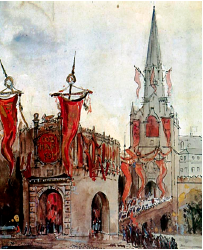
In the early stages, a certain degree of pluralism was still possible, so academic designers used traditional classical imagery alongside new symbols, such as depictions of St. George the Victorious, Pegasus, ancient chariots, banners, laurel wreaths, cornucopias, and even angels, on early Soviet posters [4]. For example, in his design for Red Square for the May 1 celebrations, Alexander Vesnin used banners reminiscent of those carried in Christian religious processions [4]. Later, against the backdrop of the anti-religious and anti-bourgeois struggle, these symbols naturally became taboo and disappeared from design elements.
Futurist designers adopted an alternative artistic stance. The Futurists’ aesthetic system employed such expressive devices as the grotesque, the unexpected, and the shocking. This entailed a complete rejection of literal interpretations, the use of neologisms, and images that were either transformed or primitively simplified in the style of folk prints. The Futurists’ favorite form of visualizing the meaning and content of the holiday was theatrical actions and performances. The most unusual places served as the stage, such as trams with cargo platforms in the form of trailers. Great importance was attached to the participants’ whimsical costumes and makeup [6, 7, 8].
The Futurists’ actions were always emotionally striking, but often pointless. It has been documented how Futurist artists, dreaming of transforming the lifeless stone expanse of Marsovo Pole in Petrograd into a blooming garden, planted 60,000 acacia and willow bushes there in time for the 1st May of 1920. But, like many other Futurist actions, the project proved unsuccessful: by mid-summer, all the bushes had withered away due to the lack of a scientific approach to planting guidelines and proper care [8, p. 74].
The most successful examples of festive city decorations were created by the Constructivists. They applied the principles of compositional structure to objects within the context of a new visual art form: design. Their works were distinguished by an innovative approach to the selection of expressive means and symbolic systems. The design of the Constructivists’ exhibition solutions was avant-garde and enthusiastically incorporated the graphic symbols of the new ideology — the hammer and sickle, the red star, and portraits of revolutionary leaders [9, 10]. Furthermore, the Constructivists were distinguished by a recognizable visual language that stood apart from all others. Its characteristics were reflected in stylized graphics and typography, in color schemes, and in compositional dynamics. The Constructivist style combined the conciseness of functionalism with passionate artistic emotionality [11].
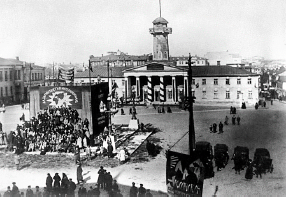
The design of the exhibition encompassed all elements of the spatial environment — streets, cars and carriages, the arrangement of crowds in processions and columns, costumes, makeup, and sometimes even the participants’ masks. To emphasize the ideological grandeur of the event, the Constructivists created large-scale street compositions that were either permanently installed at the focal points of festive events or moved along with the processions [9, 10, 11].
The decorations were often complemented by giant figures and thematic installations. Thus, in his article “Chronicle of Leningrad Celebrations, 1919–1922,” Adrian Piotrovsky describes such large-scale street installations as a giant figure of a bourgeois with a pitchfork aimed at him, or an elephant bearing the inscription “USSR” and a dog named Moska bearing the inscription “Yellow Press”, the Red Ghost of Communism, and many others [3]. These images of political caricature attracted attention, amused the public, and, at the same time, carried an ideological and political message.
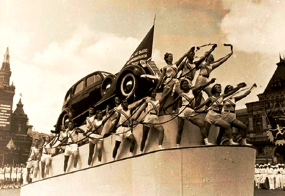
Another favorite subject of exhibition design was transportation. Cars were most often decorated, serving not only an aesthetic purpose but also as a symbol of the new era, progress, and prosperity brought about by the Soviet government’s policies. In addition to cars, other vehicles were decorated, such as trams, carts, and mobile stage platforms for propaganda performances. Sometimes cars, as symbols of progress, became part of the festive installation themselves [11].
Like the Futurists, Constructivist artists favored performative forms of visual art, as these were dynamic, processoriented, and allowed for the boldest artistic experiments. Their innovative techniques contributed to the development not only of exhibition and graphic design, but also of cinema and theater [7, 12].
The most accessible and popular element of festive decoration was the propaganda poster. The poster art of the Constructivist artists became a model of avant-garde graphic design, a phenomenon that remains the subject of art historical research worldwide to this day. The festive propaganda poster served as a space for creative experimentation. Constructivist graphic artists employed every innovation — both technical and aesthetic — in this small-scale print medium. The posters’ expressiveness was achieved through modernist typography, the incorporation of photomontage into the imagery, an unconventional compositional structure, and a vivid color scheme in which the symbolic color red always dominated. An important element of the poster message was memorable, often poetic slogans, which created an effect of the fundamental nature and aesthetic integrity of the new Soviet ideology and helped convey the idea of the monumentality and simplicity of a new, yet already established, worldview [13].
Leading graphic designers who employed the Constructivist method combined their design practice with teaching. The first higher education institution in Russia to train professional designers was the Higher Art and Technical Workshops. Leaders of the Constructivist avant-garde taught at this institution — Alexander Rodchenko, Vladimir Tatlin, El Lissitzky, Alexander Vesnin, the brothers Vladimir and Georgy Stenberg, Lyubov Popova, Varvara Stepanova, and many others. Engaged in active creative experimentation, these artist-educators involved their students in the design of festive events. Together, they developed concepts for exhibition design, wrote scripts, designed graphics and set pieces, and crafted costumes.
The exhibition and design work of the Higher Art and Technical Workshops faculty and students served as an experimental foundation for exploring new approaches to the artistic design of venues for large-scale urban festivals. Their method was based on characteristics such as scale, theatricality, spectacle, and ideological symbolism. This was a new direction not only in design and educational activities — as part of their coursework, students carried out real-world social commissions with a propaganda focus [14, 15].
In 1921, the Society of Young Artists was founded at the Higher Art and Technical Workshops within A. Rodchenko’s studio; its members created festive decorations for Moscow, Petrograd, and other cities in Soviet Russia [14].
Another example of student activism was the political carnival organized and held in 1929. The event was dedicated to the anniversary of the opening of Gorky Park and was an impressive spectacle that captivated the residents of Moscow. Installations were crafted from scrap materials, satirically depicting the ideological opponents of the USSR. Their creation represented a synthesis of professional and amateur art. Giant images mounted on 54 vehicles paraded through the city streets in a solemn procession. With minimal financial costs, the propaganda effect was deafening [15].
Discussion and conclusion. The primary goal of the organizers of the festive celebrations was to mobilize the masses. By involving ordinary people in the festivities, they helped them embrace the ideological fervor of the event and accept the communist worldview as the only possible one. In the minds of the citizens of Soviet Russia, a belief was taking shape in the new, unlimited possibilities of a “bright future,” despite the harsh realities of everyday life.
Holidays served as a means of sublimating all social, economic, and political problems, and as a way to channel the psychological distress caused by material and emotional hardships into conscious civic engagement, which gave people a sense of the significance of their own existence and hope for a better future. For this reason, the organization and preparation of large-scale holiday events were part of state policy.
In an atheist state that had imposed a strict ban on religious worship, it was essential to establish new moral and ethical standards, as well as new goals and ideals. A declarative approach to this task was completely ineffective, so the Soviet government borrowed the methods of influencing the mass consciousness that church institutions had used for centuries. In essence, the new revolutionary holidays differed little from traditional religious ones in terms of their scripted, visual, and psychological approaches.
The involvement of young people, who had little historical experience and were more receptive to various innovations, took on particular importance. This is precisely why they were actively encouraged to participate in festive events in various role-playing contexts, particularly in activities aimed at visualizing the urban environment. A striking example of this political intent on the part of the state authorities was the involvement of the Higher Art and Technical Workshops students in design work. This served at least two purposes: on the one hand, the younger generation was educated within the paradigm of the new ideology; on the other, it introduced a bold, experimental approach to design work and did not require additional expenses for labor costs, which was positive from both a strategic and tactical standpoint.
1. Kustova E. Soviet Celebrations of the 1920s: In Search of Masses and Spectacles. Neprikosnovennyy zapas. 2015;101(3). (In Russ.) URL: https://www.nlobooks.ru/magazines/neprikosnovennyy_zapas/101_nz_3_2015/article/11509/?ysclid=mo1x6osyrr261808704 (accessed: 10.12.2025).
2. Kucher K.Gorky Park: Leisure culture in the Stalin era. 1928 –1941. Moscow: ROSSPEN; 2012. (In Russ.)
3. Chechetin A.I. History of Mass Folk Festivals and Performances. Moscow: MGIK; 1976. 117 p. (In Russ.)
4. Khrenov N.A. Entertainment in the Age of Mass Uprisings. Moscow: Nauka; 2006. 646 p. (In Russ.)
5. Rolf M. A Hall of Mirrors: Sovietizing Culture under Stalinism. Slavic Review. 2009;68(3): 601–630. https://doi.org/10.1017/S0037677900019768
6. Slesar E.A., Kibardin A.A. Trends of Genre Genesis in Performing Arts. Bulletin of KemGUKI. 2018;43:175–182. (In Russ.)
7. Piotrovsky A.I. Theatrical Heritage: Studies, Theater Criticism, and Dramaturgy: in 2 vols. Edited by A.A. Teplov. St. Petersburg: Baltic Seasons; 2019. Vol. 2. 1104 p. (In Russ.)
8. Piotrovsky A.I. Chronicle of Leningrad Celebrations, 1919–1922. Mass Celebrations. In: Collection of the Committee for the Sociological Study of the Arts. Leningrad: Academia; 1926. p. 56. (In Russ.)
9. Leningrad in Festive Attire: Insights from Artistic and Political Design: A Photo Album. Compiled and written by L.N. Tsarev and N. M. Bykov. Leningrad: Lenizdat; 1981. 120 p. (In Russ.)
10. Artistic Design of Public Celebrations in Leningrad, 1918–1931. An album of 48 plates (postcards). Moscow–Leningrad: OGIZ-IZOGIZ; 1932. (In Russ.) URL: http://www.raruss.ru/soviet-constructivism/3956-guschin-registrationmass-holidays.html (accessed: 13.02.2026).
11. Murray N. Art for the Workers. Proletarian Art and Festive Decorations of Petrograd, 1917–1920. Leiden: Brill; 2018. 303 p. https://doi.org/10.1017/slr.2019.217
12. Schechner R. Performance Theory. Translated from the English by A. Aslanyan. Moscow: V-A-C Press; 2020. 486 p. (In Russ.)
13. Girin Yu.N. The Worldview of the Avant-Garde Era: The Avant-Garde as a Systemic Whole. Moscow: IMLI RAN; 2013. 400 p. (In Russ.)
14. Galaktionov A.A. VKhUTEMAS-VKhUTIN. Professor Rodchenko’s Pedagogical Principles. Decorative Arts and the Spatial Environment. Bulletin of the Russian State University of Design and Applied Arts. 2010;3:24–34. (In Russ.)
15. Ermolin E.A. The Materialization of a Ghost: Totalitarian Theater in Soviet Mass Events of the 1920s and 1930s. Yaroslavl: YAGPU Publishing House; 1996. 141 p. (In Russ.)
Berdnik Tatyana Olegovna, Cand. Sci. (Philosophy), Professor, Department of Design, Don State Technical University, Rostov-on-Don (1, Gagarin Sq., 344003, Rostov-on-Don, Russian Federation)
Komaristaia Yulia Sergeyevna, master’s student, Department of Design, Don State Technical University, Rostov-on- Don (1, Gagarin Sq., 344003, Rostov-on-Don, Russian Federation)
Berdnik T.O., Komaristaia Yu.S. The Political and Aesthetic Context of Revolutionary Celebrations in Soviet Russia. Science Almanac of Black Sea Region Countries. 2026;12(2):63-68. https://doi.org/10.23947/2414-1143-2026-12-2-63-68
 Email this article (Login required)
Email the author (Login required)
Email this article (Login required)
Email the author (Login required) 344000, Rostov-on-Don, Gagarin sqr, 1, building 8, office 411.
Tel/fax: +7 (863) 273-86-63
e-mail: science-almanac@mail.ru