Contents
Scroll to:
https://doi.org/10.23947/2414-1143-2026-12-2-53-62
Scroll to:
Introduction. The article is devoted to the analysis of animalier art of Soviet artists of the 20th century, presented at the exhibition of the Institute of Living Systems of DSTU. The scientific problem of the study is caused by the lack of comprehensive work on cultural analysis of works that reveal the theme of the unity of man and animals in Soviet art of the second half of the 20th century. The purpose of the article is to identify the historical, cultural, artistic and ethical value of these works. Tasks include attributing previously unknown canvases and determining their role in the context of the realistic tradition of the academic school, represented by the names of L.V. Turzhansky, A.A. Plastova, V.S. Tsigal and others. The relevance of the work is justified, on the one hand, by the lack of research publications on this topic, and on the other, by the increasing status of the animal vector in the modern cultural space.
Materials and Methods. The study is based on the analysis of paintings from the exhibition of DSTU, including the work of graduates and teachers of the Moscow State Art Institute named after V.I. Surikov. Descriptive, historical, cultural, iconographic and stylistic analytical methods were used as scientific methods. This approach made it possible for the first time to introduce previously unknown samples of fine art into scientific circulation and systematize them according to their artistic and thematic significance.
Results. It was revealed that the presented paintings of the Soviet animalier art masters reveal a little-studied cultural layer in the history of Russian art. It was determined that the key value guidelines in the work of artists were the unity of man with animals, the development and preservation of wildlife as an integral part of the biosphere. It was established that the reflection of the integrity of the natural world in the period under study formed a new ethical and aesthetic understanding of spiritual values in the creative worldview of Soviet painters.
Discussion and Conclusion. It was concluded that the studied works have not only high artistic value but also significant historical and cultural potential. The practical significance of the work lies in the possibility of using materials to further comprehend the role of animalism in the context of Soviet realism. Research prospects are connected with a deeper study of the relationship of artistic images and ethical ideals of the era, as well as with the integration of these materials into museum and educational programs.
Gurzhieva I.P., Ermakov A.M. Cultural Significance of Animalier Art of Soviet Painting Masters on the Example of the Unique Exhibition of DSTU. Science Almanac of Black Sea Region Countries. 2026;12(2):53-62. https://doi.org/10.23947/2414-1143-2026-12-2-53-62
Introduction. The unique exhibition 'Life of Soviet Animals', created at the site of the Institute of Living Systems of DSTU, is devoted not only to animalier art in the work of masters of socialist realism but above all in genre painting which reflects the work of Soviet livestock breeders, milkmaids, pig-tenders, shepherds and veterinarians who determined the well-being and growth of the post-war national economy of the USSR. However, behind this external, production layer, a deep philosophical content opens up: the artists captured not just labor processes but a special type of being in which man and animal exist in indissoluble unity. This symbiosis, rooted in a thousand-year-old peasant culture, in the 20th century underwent tremendous transformations under the influence of wars, industrialization and urbanization. Painting became a way to preserve the memory of this disappearing world where the relationship between man and animal was built not on the principles of exploitation but on mutual service and joint survival. In essence, we have a unique visual archive that captures one of the fundamental forms of human presence in the world, a form based on a dialogue with a different, unhuman being.
If we turn to the history of the genre, it is important to imagine that fifteen thousand years separate the rock carvings of bison in the caves of Altamira from the bulls close in realistic performance by Pablo Picasso, who was inspired by the great heritage of his native Spain. This huge time gap testifies to the archetypal nature of the animalistic image: the animal was the first Other with whom man entered into dialogue, the first object of knowledge and the first mirror in which they tried to see themselves. Cave painting is not just a hunt, it is a magical act, an attempt to establish a connection with the forces of nature, curb them, tame them. In this sense, Soviet animalier art inherits this ancient magical function of art: it also tries to establish, restore the connection of man with natural space, disrupted by war and technological progress.
Animalier art as the first act of creativity in the era of primitive art, presented humanity with amazing embodiments of aesthetic experience in the powerful realism of animal forms and movement. This experience was syncretic in nature: it merged utilitarian (success on the hunt), sacred (reverence for the totem) and aesthetic (joy from the exact reproduction of the form). Soviet artists, perhaps without realizing it, reproduced this archaic model: their interest in animals was far from cold academism, it felt the same ancient surprise at the perfection of natural forms, the same attempt through the image to master the essence of a living being [1, 2].
Masters of ancient Greece created magnificent images of horses, that were revived in all their greatness during the Renaissance in monumental sculpture, mosaics and painting. Remarkable images of animals in the works of great Renaissance artists: Leonardo da Vinci, Michelangelo, Titian, Durer, Brueghel are the pinnacle of the genre, since the images were based on painstaking studies of anatomy, which made it possible to accurately reflect the beauty and habits of animals even in paintings, where they became staffage, bearing a symbol of human relations. In Renaissance culture, the animal had a complex semiotic function: it could be a symbol of vice (for example, a hare by Titian) or virtue (a lamb by Jan van Eyck), but it always retained its material, bodily specificity. This balance between symbol and reality, between idea and flesh, was inherited by the Russian academic school. However, in Soviet art, especially post-war, the symbolic layer often gave way to the existential: the artist was interested in the animal not so much as in a carrier of abstract meaning but as in a living, suffering and rejoicing creature that shares the historical fate with a person.
In the art of modern Russia, the training of Russian artists at the Academy of All Noble Arts based on European artistic traditions played a decisive role in the formation of the school of the animalistic genre. The first Russian artists were taught by foreigners who came to Russia, J.F. Grooth, K.F. Knappe, engraver I.S. Klauber, in the class 'Animals and Birds' in the last third of the 18th century. The very separation of animalism into a separate educational discipline was deeply symbolic: it meant that the image of an animal had independent artistic value, and was not just auxiliary material for historical or battle painting. In the 19th century in Russian painting, the themes of hunting, the equestrian art and the 'breed portrait' acquired a professional academic level [1].
The founder of the genre of animalistic sculpture, Peter Clodt von Jurgensburg, determined the method of depicting horses based on the work from life, which became the fundamental principle of academic art. His horses on the Anichkov Bridge are not just a sculptural decoration of St. Petersburg, they are a philosophical reflection on the nature of power, on the conquest of the elements, on the relationship between the ancient ideal and Russian reality. The rich legacy of the battle academicians Nikolai Egorovich Sverchkov, Pavel Osipovich Kovalevsky and Nikolai Semenovich Samokish had a decisive influence on the development of battle painting and the animalier art genre in Russia and the USSR, presenting examples of a deep understanding of nature in the equestrian genre. In their work, the horse ceased to be just a 'vehicle' of the warrior, it became a full-fledged participant in the historical action bearing the brunt of the Russian military history.
In the presented exhibition, the atmosphere of the post-war years of the last century lives in paintings and small plastic arts, when animalier art took an equal place among other genres of Russian fine art. It was a time of profound existential fracture: the war with its total dehumanization, with treating man and animal as 'cannon fodder' or 'beasts of burden', produced a powerful compensatory response. Artists sought to return to the world its lost integrity, and the animal in this coordinate system acted as a carrier of authenticity, as a creature that did not lose its organic connection with being. In this sense, post-war animalier art can be understood as a form of existential art: it captures the moment when a person who has survived the horror of nothingness tries to rebuild relations with the world, starting with the simplest and most fundamental, with an attitude to a living being. In the second half of the 20th century painters, organically revealing images of animals in everyday and landscape paintings, first of all painted sketches from life for both battle and genre work. Captured by painting horses and cows from life, revealing their role in human life, Soviet masters succinctly conveyed real plots and themes that we saw anew today, through comprehension of a distant and difficult but happy time. The time of the post-war decades, when artists yearning for a peaceful life painted what they knew and loved, their native nature and its inhabitants [3].
The Soviet school of fine art in the animalier art genre represents the richest legacy of the works of Mitrofan Grekov, Vasily Vatagin, Konstantin Flerov, Valentin Belyshev, Leonard Turzhansky, Sergei Gerasimov, Vladimir Stozharov, Alexei Gritsai, Arkady Plastov. The relevance of the article is that for the first time it explores unknown samples of fine art in the context of a unique exposition material. The paintings of famous and forgotten Soviet masters reveal to the viewer artistic presentations of those human values that must be re-understood in their enduring aesthetic and ethical significance. In the era of total digitalization and virtualization of reality, these canvases return us to the tactile, bodily, living experience of interacting with the world, recalling that a man is only part of a huge, complex space, and their well-being directly depends on the state of this space. They raise a critical question: what does it mean to be alive among the living? Is it possible to preserve the human in man without dialogue with other forms of life?
Materials and Methods. The study is based on the material of Soviet paintings of domestic and landscape genres, including an animalistic theme which are presented at the exhibition 'Life of Soviet Animals', created at the site of the Institute of Living Systems of the Don State Technical University. The investigated corpus of materials covers the period from the second third to the end of the 20th century and includes works created in different regions of the USSR. Descriptive, historical, iconographic, iconological and stylistic analytical methods for the study of works of art were used as scientific methods. However, to achieve the goals of the study, it was also necessary to turn to the methods of philosophical hermeneutics and phenomenology of art, allowing us to consider the work of art not just as an object but as an event when the artist's consciousness meets the world.
The descriptive method made it possible to fix the external characteristics of the works: plot, composition, color, techniques. The historical method made it possible to fit these works into the context of the era of their creation, to correlate with the social, economic and political processes that took place in Soviet society. Iconographic and iconological analysis, dating back to the traditions of the school of Aby Warburg and Erwin Panofsky, was applied to identify hidden symbolic meanings that may be behind the images of animals. This method made it possible to see echoes of ancient mythologies, archetypal ideas about fertility, sacrifice, resurrection in seemingly everyday scenes. Stylistic analysis made it possible to determine the belonging of works to one or another artistic movement (socialist realism, 'Severe Style', impressionistic tendencies) and trace the evolution of the creative manner of individual masters.
The use of the phenomenological approach developed in the works of Edmund Husserl and Maurice Merleau-Ponty was of particular importance for this study. From a phenomenological point of view, the image of an animal is not a copy of the external form but an attempt to penetrate the way of animal`s being, to understand its 'inner world', its otherness. Merlo-Ponti in his later works reflected on the 'flesh of the world', uniting all living things, and that an animal is not just an object among objects but a different mode of sensuality, a different way to feel and react to the world. Soviet animalists, working from life, intuitively approached this understanding: their task was not just to draw a cow or a horse but to catch that elusive, special rhythm of existence, special physicality, special attitude to space and time.
Results. The article for the first time explores unknown works of Soviet artists in the context of a unique exposition material. Paintings of both famous and unjustly forgotten Soviet masters reveal to the viewer artistic embodiments of those human values that must be reinterpret today in their enduring aesthetic and ethical significance [4].
The rarest example of the work of the outstanding painter People's Artist of the USSR Arkady Alexandrovich Plastov is a monochrome pictorial sketch (using umber) for the painting 'Milk Mug', created in 1942, presented at the exhibition. The composition is filled with warmth of kindness, despite the harsh flavor of a winter day in a devastated village with burnt huts. This asceticism of the palette is deeply symbolic: the war seemed to discolor the world, joy left it, only basic, existential values remained: bread, milk, life. In this work, there is an awareness that during the years of war the man's faithful friends (a war horse and a nurse cow, reliably painted from life) were indivisible with their fate. Plastov avoids sentimentality, his animals are not humanized, they retain their animal nature, but it is this 'otherness' of them that makes their presence especially significant. The horse and cow in his sketch are not symbols but living beings who share hardships with a man. This attitude, far from the modern consumer view of animals, goes back to the archaic, peasant attitude, where an animal is not a resource but a family member, an accomplice in being. The war did not reach the native village of Arkady Plastov, where he worked in these harsh years, but the artist's paintings such as 'The Fascist Flew By' are filled with pain about the Great Patriotic War which turned the country's peaceful life upside down. In the context of all Plastov's work, this sketch appears as an important link in his thoughts about life and death, about what remains unchanged in the era of disasters [5, 6].
A remarkable work of the exhibition is a large painting by the painter Alexander Vasilyevich Volkov 'A Cow Harnessed to the Sleigh', painted in the late 1940s (Fig. 1). The happiness of women who survived the war, sitting in a sleigh, is read in faces ruddy from the frost, sparkling with fun. The figure of a cow is masterfully painted against the background of a winter forest, harnessed to the sleigh. Characteristic female images are depicted with attention. The paradoxical composition makes you think about the horseless post-war economy and the strong Russian character of workers who overcame the hardships of the post-war years. However, the philosophical subtext of the painting is deeper: a cow in traditional culture is a symbol of fertility, motherhood, cosmic female strength. Harnessed to the sleigh, it becomes not a humiliating replacement for a horse but a bearer of the sacred principle, a kind of goddess leading people. In this sense, Volkov's painting can be read as an allegory for the revival of life: the feminine (peasant women) and the life-giving force of nature (cow) unite to confront chaos and death. In the same wide picturesque author's manner, close tonal relations, the artist created images of villagers . a peasant leading the horse by the halter in a winter forest in the large-scale painting 'A Man Leading a Horse' and a peasant sitting at the entrance to a snowy household yard with a bull nestled close to hay, on the canvas 'On the Courtyard'. Here animals and man form an inextricable plastic and semantic whole demonstrating archaic, pre-modern unity where there is no place for hierarchy and domination.
Temperamental in color and texture pictorial sketches were created with a subtle sense of the native Ural nature by the outstanding Russian Soviet painter Leonard Viktorovich Turzhansky [7]. Hungry large-boned horses and sinewy goats near the outskirts looking for the first grass on spring land are painted impressionistically with the expressiveness of an artistic-shaped characteristic. Turzhansky does not idealize animals, he shows them as they are: tired after a long winter, hungry but hardy. This truth of life gives his works particular persuasiveness. However, there is a deep philosophical experience behind this external unpretentiousness: the artist captures the moment of nature awakening that borderline status between winter and spring when life barely glows, but it is already ready to flare up in full force. Modest lyrical views which reflect the life of the village fenced pastures glorified the artist as the national landscape painter of the Soviet country. In his works, the animal is not the main character but an integral part of the landscape, as natural an element as a tree, cloud or spring stream. This is evidence of a deep ecological consciousness based not on environmental slogans but on an organic sense of ownership of the natural whole.
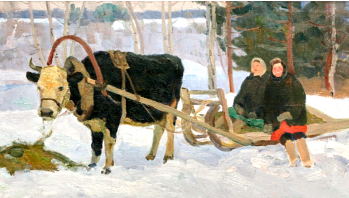
Fig. 1. Volkov A.V. A Cow Harnessed to the Sleigh. 1948. Canvas, oil, 53 × 90 cm
The painting 'Collective Farm Yard' by the Honored Artist of the RSFSR Lev Iosifovich Naroditsky of the era of severe style of the 1960s was marked by a high artistic level (Fig. 2). The work reflects the traditions of the Moscow school of painting and the method of his teacher, a subtle Russian impressionist, professor at the Moscow State Art Institute named after V.I. Surikov, People's Artist of the USSR Sergei Vasilyevich Gerasimov. The influence of the landscape vision of Valentin Alexandrovich Serov is revealed in the tonal transmission of the light-air atmosphere of a gray day in the space of a snowy courtyard with a hungry cow buried in a feeder. In the context of the 'severe style', this image acquires an almost epic sound: this is not a complaint, but a courageous acceptance of one's share, a stoic carrying of the cross. Naroditsky's cow is not just an animal but a symbol of the hard, exhausting labor that befell the post-war generation. It stands in the center of the composition as a monument, as the personification of the entire post-war, enduring and victorious Russia.
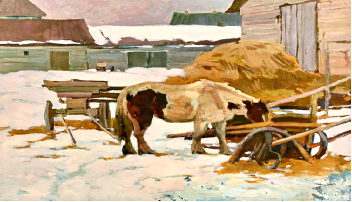
Fig. 2. Naroditsky L.I. Collective farm yard. 1960s. Cardboard, oil, 60 × 86 cm
The magnificent image of the horse in the stable 'Stallion in the Stable' is painted with professional nobility of life (Fig. 3). The image method is marked by attention to the aesthetic value of painting and goes back to the authorship of Pyotr Dmitrievich Pokarzhevsky, a famous teacher, battle painter who taught to depict the horses of students at the Moscow State Art Institute named after V.I. Surikov, among whom there was Boris Tikhonovich Sporykhin, who became the first people's artist of the RSFSR on the Don [8]. The painting was created at the Terek stud farm in Pyatigorye where students worked in summer practice under the guidance of Professor Pokarzhevsky. The stature and noble beauty of the Terek stallion, standing in the gloom of the stable, is conveyed in the overflows of a brownish-umber scale with soft scumble in the finest nuances of chiaroscuro. There is something timeless, almost sacral, about this image. The darkness of the stable becomes not just a household detail but a symbol of the mystery of being from which a perfect form emerges. Pokarzhevsky's stallion resembles an antique horse that descended from the Parthenon frieze, it is just as eternal and beautiful [9].
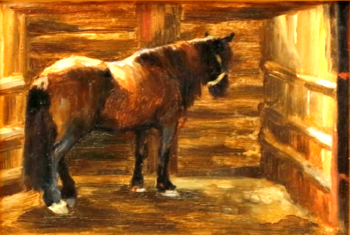
Fig. 3. Pokarzhevsky P.D. Stallion in the stable. 1950s. Cardboard, oil, 18 × 23 cm
The figure of the horse in the painting 'Piebald gelding' is not less expressive, painted by the People's Artist of the USSR Taras Guryevich Gaponenko, who graduated from the Higher Art and Technical Institute in Moscow (workshop of N.M. Chernyshev) (Fig. 4). The artist's great composition 'For Lunch to Mothers' (1935), awarded the Gold Medal at an international art exhibition in Paris, brought all-Union fame and European fame to the artist. The artist devoted his best paintings to the theme of collective farm labor, animal husbandry and poultry farming ('In the Bird Town' 1959), as well as portraits of horses, cows and goats. The images of animals presented at the exhibition, like the 'Piebald gelding' were painted by the master in his native Smolensk region, where the artist spent his childhood and youth. In this simple, unassuming image there is that authenticity that is characteristic only of art that grew out of personal experience. Gaponenko does not strive for showiness, his horse is an ordinary working horse, but there is so much nobility and calm strength in its appearance that it becomes a symbol of the entire Russian land that has survived the occupation and been restored from the ashes [10].
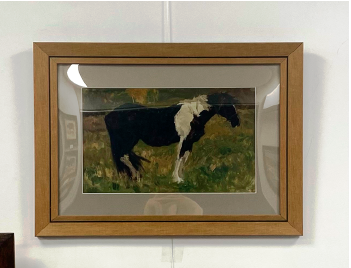
Fig. 4. Gaponenko T.G. Piebald gelding. 1960s. Cardboard, oil, 26 × 39 cm
The author of the genre painting 'On the Pig Farm' is the Leningrad muralist Evgeny Viktorovich Kazmin after studying at the Rostov Art College named after M.B. Grekov graduated from the Leningrad Higher Art and Industrial School named after V.I. Mukhina (Fig. 5). The peculiarity of this work is revealed in the process of growing piglets on the farm, accurately reflected from life. The huge, well-equipped hall with tireless pigs leading care, weighing newborns and bathing sows, is painted boldly. A special note of humor is introduced, there are mothers, enlarged in the foreground, cheerfully looking from the nursery, surrounded by piglets. This humanization of animals, attributing human emotions to them, makes the painting especially warm and attractive. However, there is a deeper philosophical subtext: Kazmin shows the triumph of life in its most immediate, biological manifestation. Piglets, sows, caring pigs, all these are links in a single process of reproduction of life which is not afraid of any ideological storms. In this sense, the painting becomes the anthem of vitality, the very vitality that, according to Henri Bergson, permeates everything that exists and is the true basis of reality.
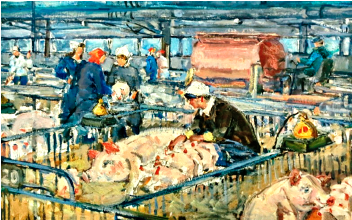
Fig. 5. Kazmin E.V. On the pig farm. 1970s. Cardboard, oil, 46 × 66 cm
In another format, in the traditions of the Russian peasant genre with subtle pictorial plasticity in the transmission of animal movement, the painting 'Hog house' by Vladimir Fedorovich Tokarev (Fig. 6), a famous Russian painter who began his career on the Don and headed the House of Creativity 'Academic Dacha' of Union of Artists of the USSR in Vyshny Volochek. The composition discloses the space of a dark adobe barn with food-seeking figures of pink piglets illuminated by sunlight penetrating the splits in a roughly folded door. Light breaking through these splits becomes a symbol of hope, life breaking through any obstacles. Tokarev works with the contrast of light and shadow in an almost caravaggesque manner, creating an almost tangible atmosphere of a peasant farmstead. His piglets are not just farm animals but living, touching creatures that evoke a viewer's smile of affection. However, there is no sentimentality in this affection, it is based on a genuine interest in life as such, in its smallest manifestations.
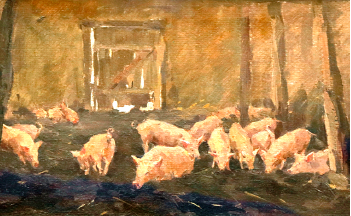
Fig. 6. Tokarev V.F. Hog house. 1960s. Canvas, oil, 18,5 × 19,5 cm
The portrait of a cow in the painting 'Cow in the Byre' is plastically expressive, with knowledge of anatomy created by the Saratov painter, Honored Artist of the RSFSR Pyotr Alekseevich Grishin. His cow is painted in a dense, textured brushstroke that conveys the heaviness and power of the animal. Grishin seems to sculpt the form with color, achieving almost sculptural tangibility. Cows in the painting 'Herd in the Summer Camp' by Stalin Prize laureate Nikita Nikanorovich Chebakov are depicted impressionistically with bold relationships of bright color spots. Chebakov works widely, decoratively, creating a festive, major image of the Soviet village. The beauty of tonal relationships is revealed in the sketch from life 'On Vacation' by the Moscow artist Vasily Pavlovich Komardin where the figures of resting animals are inscribed in the soft, lyrical environment of the Russian landscape.
Inseparably with the Don landscape, a herd of cattle was painted on the river bank in the work of the People's Artist of the Russian Federation Boris Tikhonovich Sporykhin 'At the Don'. Sporykhin, a student of Pokarzhevsky, brilliantly conveys the state of a wide, free Don landscape. His cows are part of this expanse, they seem to grow from the ground, from the grass, from the river moisture itself. Bright accents depict the figures of cows in the sketches of the Don landscape painter, Honored Artist of the RSFSR Alexander Vasilyevich Timofeev. In the sound of red, brown and reddish accents, applied with a wide brushstroke, his painting 'When the evening comes (The return of the herd)' with an avalanche of Don cows going on in the gloom of a sultry sunset is painted. It's not just a herd, it's an element, a natural force, indomitable and beautiful. In the foreground, a cheerful Cossack with a long gray beard is expressively painted accompanying a detachment of cows on a bicycle. This genre motif brings a note of modernity to the traditional pastoral plot creating a kind of bridge between the eternal and the transient. People's Artist of the RSFSR Nikolai Konstantinovich Solomin in a different style, based on an expressive drawing, academically subtly performed the watercolor work 'Milking a Cow' (Fig. 7). The bright harmony of animals and nature, the joy of a peaceful life fills the post-war solar work of artists with special love. The animals in their works are an integral part of this happy, harmonious world, and their presence informs this world of completeness and fulness.
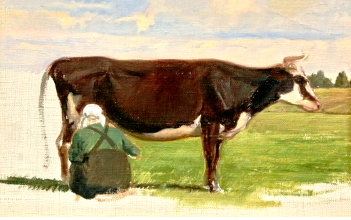
Fig. 7. Solomin N.K. Milking a cow. 1950s. Canvas, oil, 21,5 × 31,5 cm
The images of animals united with nature are painted in the form of expressive staffage in the works of a galaxy of Don painters in the period 1960-1980s. Excellent paintings were created by Yakov Evseevich Guslisty ('Herd of Horses'), Konstantin Ivanovich Areshchenko (series 'Caucasian Sketches') and Pyotr Ivanovich Glyzin ('Herd of goats at sunset'). In these works, animals no longer act as the main characters but as a necessary element connecting a person with a natural whole. They remind us that we are not alone in this world, that we are surrounded by other forms of life, other ways of existence.
A number of works presented in the exposition reflect the tasks due to the time in which the active development of the animalistic genre took place, which gained new social and cultural significance both in genre painting and in battle painting. Particular attention to the world of horses was paid by the famous Don battalists Vladimir Petrovich Chernousenko and Arseny Makeevich Chernyshev, whose wonderful pictorial and graphic sketches are presented in the exhibition. Their works are interesting because they show the horse not in a peaceful, agricultural hypostasis but in the elements of battle, where it acts as a comrade, a faithful companion of the warrior. Dynamics, expression, drama distinguish these sketches, complementing the overall picture of the animalistic genre`s development on the Don.
The study, devoted to the analysis of a whole layer of unknown paintings by Soviet authors that reveal the integrity of human and animal life, emphasizes the increasing status of the animal vector in the modern cultural space. Today, in the context of the growing ecological crisis and the revision of the anthropocentric paradigm, art that addresses the topic of animals is gaining special significance. It allows us to raise a new question about the boundaries of the human being, about our responsibility to other forms of life, about the possibility of dialogue with nature not in the language of domination but in the language of reciprocity and sympathy.
Discussion and Conclusion. After many years of oblivion, the theme of animal life in the world of the Soviet postwar village was revived by an exhibition of paintings supported by the academician of the Russian Academy of Arts and the Russian Academy of Education, Professor Besarion Chokhoevich Meskhi. The importance of curatorial and scientific support from the leadership of the institute can hardly be overestimated: without this, the project could remain unrealized, and many masterpieces could be unclaimed.
A great interest in the animal world, the reverent love of nature, the content and poetry of the images of the homeland are revealed in the unique canvases of wonderful masters, whose heritage was included in the golden fund of Soviet easel painting. The presented works have not only the value of professional artistic quality but also historical, cultural and educational significance. The ethical, moral principle was determined by the asceticism of authors whose works were painted in the Russian outback. Many of these artists led an ascetic lifestyle, deliberately abandoning the benefits of the capital for the opportunity to live and work in close proximity to their life: nature, peasants, animals. This choice is itself an act of high devotion to the art.
The studied heritage of paintings of the masters of Soviet fine art of the animalistic direction opens up a little-studied artistic and cultural layer in the history of Russian culture and art which determines the value-based artistic and ethical guidelines that are ideologically important in the history of our country. Among these guidelines, there is the union of man with the animals raised and used on the farm and in the service, the development and preservation of wildlife indivisible with the human habitat. From a philosophical point of view, this legacy can be understood as evidence of a special type of attitude towards the Other . not anthropocentric, not egocentric but based on the recognition of the selfworth of any living being. Soviet animalists, perhaps without realizing it, created a visual anthology of this attitude, so rare in the modern world. As a result, deep understanding is given to the socio-cultural significance and aesthetic value of artistic images, masterfully painted from life and revealing the role of animals and nature in human life. The presented works, which is especially important, retained the joyful impulse of our Motherland, heroically revived by the people from the ruins of the Great Patriotic War in the second half of the 20th century. This joy is not lightweight and thoughtless but achieved through suffering, conquered at the cost of incredible efforts. It probably constitutes the main content of post-war art.
In the new millennium, when the urbanization of society severed the person's connection with historical and cultural values and nature, the ethical and aesthetic achievements of the art of the socialist era have acquired a new understanding today calling for an understanding of the role of the individual in the preservation of ecology, in the continuous connection of modernity with the heritage and traditions of the past. We are beginning to understand that technological progress, divorced from moral grounds, can lead to disaster. In this sense, the art of Soviet animalists returns us to the origins, to the basic values of being recalling that a person is only part of a huge living space.
The importance of the unique exhibition, which presented a holistic but forgotten layer of painting of the Russian academic school, for our contemporaries, and above all for student youth, lies in the enduring artistic value of the works of Soviet masters, figuratively comprehending and reflecting the life of nature and man, which is relevant today from cognitive, aesthetic and ethical points of view. For young people who grew up in the virtual world, live communication with genuine works of art becomes the most important channel of communication with reality, with the history of their country, with the existential foundations on which human life rests. The sociocultural phenomenon of the unity of man, nature and its inhabitants in the fine arts of the Soviet era of the second half of the 20th century requires a special in-depth study in the context of such areas of modern thought as ecological aesthetics and post-humanism which open up new perspectives for understanding this unique heritage of paintings.
1. Portnova I.V. Animalier art in Russia of the 18th - first half of the 20th centuries. Moscow: Sputnik; 2013. 516 p. (In Russ.)
2. Belogurova S.P. Animalism as a cultural and artistic phenomenon in social thought at the turn of the 19th-20th centuries. Dissertation of Candidate of Cultural Studies. Moscow; 2011. 218 p. (In Russ.)
3. Portnova I.V. The domestic animal-painter as well as the cultural phenomenon of the 20th century. Bulletin of the Moscow State University of Culture and Arts. 2017;79(5):157–160. (In Russ.)
4. Portnova I.V. Problems of contemporary Russian animalistic art development. Izvestia of Samara Scientific Center of the Russian Academy of Science. 2011;13(2.2):484–489. (In Russ.)
5. Kostin V.I. Arkady Alexandrovich Plastov. Moscow: Soviet artist; 1956. 56 p. (In Russ.)
6. Plastova T.Yu. Arkady Plastov “From study to picture”: articles, memoirs. Materials. Moscow: Foundation “Connection of Eras”; 2018. 416 p. (In Russ.)
7. Stankevich N.I. Turzhanskaya I.L. Leonard Viktorovich Turzhansky. L.: Artist of the RSFSR; 1982. 160 p. (In Russ.)
8. Gurzhieva I.P. Singer of the Don land. Artist Boris Sporykhin. The State M.A. Sholokhov Museum-Reserve “Quiet Don”. Rostov-on-Don; 2024. 16 pp. Rostov-on-Don; 2024. 16 p. (In Russ.)
9. Bespalova L.A. Peter Dmitrievich Pokarzhevsky. Moscow: Soviet artist; 1959. 80 p. (In Russ.)
10. Paramonov A.V. Taras Gurievich Gaponenko. Moscow: Soviet artist; 1961. 62 p. (In Russ.)
Gurzhieva Irina Pavlovna, art historian, honorary member of the Russian Academy of Arts, expert, Institute of Living Systems, Don State Technical University (1, Gagarin Sq., Rostov-on-Don, 344003, Russian Federation); Institute of End-to-End Technologies, Don State Technical University (1, Gagarin Sq., Rostov-on-Don, 344003, Russian Federation)
Ermakov Alexey Mikhailovich, PhD (Doctorate) (Biology), Professor, Head of the Institute of Living Systems, Don State Technical University (1, Gagarin Square, Rostov-on-Don, 344003, Russian Federation); Institute of End-to-End Technologies, Don State Technical University (1, Gagarin Sq., Rostov-on-Don, 344003, Russian Federation)
Gurzhieva I.P., Ermakov A.M. Cultural Significance of Animalier Art of Soviet Painting Masters on the Example of the Unique Exhibition of DSTU. Science Almanac of Black Sea Region Countries. 2026;12(2):53-62. https://doi.org/10.23947/2414-1143-2026-12-2-53-62
 Email this article (Login required)
Email the author (Login required)
Email this article (Login required)
Email the author (Login required) 344000, Rostov-on-Don, Gagarin sqr, 1, building 8, office 411.
Tel/fax: +7 (863) 273-86-63
e-mail: science-almanac@mail.ru