Contents
Scroll to:
https://doi.org/10.23947/2414-1143-2026-12-2-34-41
Scroll to:
Introduction. The urgent task of modern higher pedagogical education is to ensure the educational process՚s dialogization of future specialists, the need to prepare teachers who could introduce an educational dialogue in practice. Attention is focused not only on the importance of the assimilation of theoretical knowledge by future teachers, mastering skills during vocational training but also on the formation of the necessary personality traits that would contribute to the creation of an atmosphere of trust, mutual understanding and co-creation in the educational environment. The purpose of the article is to determine and substantiate the components and criteria of the personal readiness of future teachers to dialogize the educational process.
Materials and Methods. The main research methods, the use of which involves the development of a structure of personal readiness of future teachers to dialogize the educational process, are theoretical analysis, synthesis, generalization, comparison, systematization, content analysis.
Results. The concept of personal readiness of future teachers to dialogize the educational process, which is defined as a complex dynamic education, is outlined. The structure of the personal readiness of future teachers to dialogize the educational process is developed. Particular attention is paid to such personality traits as professional orientation, emotional intelligence, empathy, congruence, unconditional acceptance, reflexivity and the need for self-development. The complexity of the structure of personal readiness of future teachers before the dialogization of the educational process is ensured by covering all stages of professional activity: indicative, executive and control.
Discussion and Conclusion. The developed structure can be used as the basis of empirical research. The results of theoretical analysis will be useful for the development of training programs for future teachers aimed at establishing the necessary personality traits for the effective implementation of the dialogical approach in the educational process.
Kuzubov A.A. Structure of Teachers՚ Professional and Personal Training for the Formation of the Educational Process՚s Dialogization. Science Almanac of Black Sea Region Countries. 2026;12(2):34-41. https://doi.org/10.23947/2414-1143-2026-12-2-34-41
Introduction. Modern trends in education are increasingly tending to humanistic values, humanitarian essence of the school. This goal can be achieved due to a dialogue-peculiar tool that contributes to the deep assimilation of knowledge and the development of personality. At the same time, for the successful dialogization of education, pedagogical personnel are needed, who have not only theoretical knowledge but also the corresponding personality traits, which is the basis of readiness for professional activity. Despite the significant interest of researchers in the professional training of teachers, the issue of personal readiness remains insufficiently studied, and in the context of the introduction of educational dialogue, this problem has not been considered at all yet. It is important not only to define the concept of readiness but also to operationalize it in order to clear it of excessive abstractness and ephemerality.
Materials and Methods. Theoretical basis of research is competently oriented learning, concepts of educational dialogue used as the methodological basis of scientific research, determined by the purpose of learning in an educational environment. The main research methods are theoretical analysis, synthesis, generalization, comparison, systematization, content analysis.
Results. Dialogization of education is a process of rethinking the educational paradigm aimed at humanizing learning, where the interaction between participants (Teacher-Student, Student-Student) is based on the principles of equality, mutual respect, reflection and personal development.
This concept is actively developed in the context of humanistic pedagogy and psychology. A.Ju. Chistobaeva made a significant contribution to the study of the dialogization of the educational process [1]. The issues of dialogization of the educational process are also investigated by A.A. Somkin (forms of dialogical skills), L.S. Znikin, D.V. Sedykh (dialogue as a linguodidactic category) [2; 3]. Therefore, this question has long been of interest to scientists but does not lose its relevance even now. The study of the personal readiness of future teachers to introduce educational dialogue is a continuation of the sphere of scientific interest and at the same time a new and little researched aspect.
The origins of educational dialogue reach ancient times, one of the first such examples is the Maeutic conversations of Socrates. The thinker compared a person’s achievements of wisdom, true knowledge with a second birth, but now not biological but spiritual, worldview, intellectual and moral in essence. The task of the mentor in this process is to create favorable conditions, just like the midwife does. According to Socrates, the truth cannot be conveyed, it must be born within a person through a dialogue in which there are not any concrete answers, but there are equal minds with their own questions. It is commonly known that the philosopher did not leave behind a single written work and considered any text limited and even harmful, because it is unchanged and all the answers are the same.
In the modern world of Internet dominance and constant improvement of electronics, it is difficult to imagine maeutic conversations in their original form, but the very concept of Socrates’ dialogical approach is more relevant than ever.
Continuing the consideration of dialogue (broadly) as an ontological characteristic of an individual, it is advisable to recall the views of representatives of humanistic psychology (A. Maslow, C. Rogers, V. Frankl, etc.). In their opinion, the main goal of dialogical interaction is to achieve a level of self-actualization and authentic existence by increasing the boundaries of self-awareness of the person. The logical consequence of this is good psychological well-being. S. Kaufmann notes that this is not necessarily a pleasant experience, but those associated with the emergence in life of a new meaning, involvement and growth — the basic concepts of humanistic psychology [4].
If the educational dialogue is in the mode of being, in accordance with the concept of E. Fromm, then traditional education is an example of the mode of possession. The psychologist compares exemplary excellent students with wellinformed guides in the museum who can reproduce a large amount of memorable information, but they do not know what goes beyond such knowledge-property. They do not learn to ask questions, understand internal contradictions, distinguish the true thoughts of the author from those attributed to him and much more [5].
This idea continues in the works of M. Csikszentmihalyi. The creator of the flow concept notes that many people stop learning as soon as they finish school, because thirteen or even twenty years of coercion to knowledge carries too many negative emotions for them. Their attention has been managed by teachers and textbooks for too long, therefore they perceive the end of education as liberation [6, p. 147].
Thus, unlike the traditional teaching model, where knowledge is transferred unilaterally by the teacher, educational dialogue is a much more complicated process.
As N. Pavelko notes, for an effective dialogue, only a formal act of communication is not enough, because it “is based on manipulating the consciousness of another person, impersonally addressed to everyone, and practically reduces training to learning”. The scientist considers educational dialogue as such an intentional act of communication, which “is addressed to everyone individually, provides an opportunity for the student to independently and freely build their own value system in the process of experiencing value positions, emotional and reflective attitude to the values of another and their own, which turns the value attitude into a holistic spiritual, and not one-sided — emotional or rational” [7, p. 5].
Readiness for any type of activity is the key to its successful implementation and a painless process of activity. Educational dialogue is not an exception, in particular, the personal component of the specialist’s readiness.
We consider the personal readiness of the future teacher to dialogize the educational process as a complex dynamic education of the personality of the future teacher, represented by internal attitudes towards congruent, benevolent and meaningful relationships in the educational environment in order to form a holistic student personality [8].
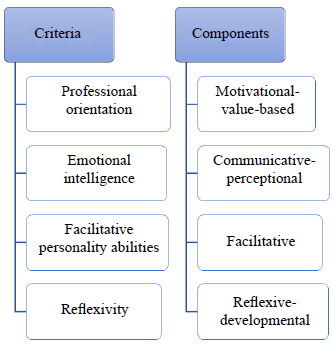
To analyze the components of personal readiness, we identified 4 criteria that correspond to the 4 generalized components (Fig. 1).
Among the criteria, it is primarily important to consider professional orientation. According to A. Kandaurov, broadly, professional orientation is a system of emotional relationships, a hierarchical structure of motives that prevail and encourage the individual to embody them in professional activity. Narrowly, this is a professionally important property that occupies a central place in the personality structure of a specialist and determines their individual typological identity [9, p. 76]. In turn, S. Lushnikova draws attention to the professional orientation as a person has a steady interest in a certain, separate type of activity and a tendency to engage in it [10].
Such interpretations lead to an analysis of the value-semantic orientations of the individual. O. Berezkina draws attention to the fact that they appear, are fixed and adjusted in the professional activities of the individual. At the same time, the process of formation of value-semantic orientations and professional activity are mutually determined [11].
According to this statement, future teachers already during their studies, at the time of the first contact with their profession, begin to weave the professional “I” into the structure of their own personality on the basis of a steady interest in the profession, and begin their professional self-existence.
Professional self-existence is one of the most important forms of life self-existence. For students, the intraprofessional form of this phenomenon is relevant (professional self-improvement aimed at increasing professional competence and developing professional qualities).
On the way to dialogizing education, the first steps are deep motivation in vocational training, interest in their own personal improvement for the ability in the future to put the ideas of a humanistic approach to training into practice. Therefore, the first criterion analyzed corresponds to the motivational-value-based component.
Let us pay more attention directly to pedagogical communication, which is based on subject-subject relations mediated by the initial subject.
Experts in the field of socio-emotional learning argue that the socio-emotional competence and positive well-being of teachers significantly affect the educational context. The personality traits of teachers shape the nature of their relationship with students. Groups with warm relationships between teachers and students contribute to the deep assimilation of knowledge by students: children who feel comfortable with their teachers and peers master difficult material with great zeal and persistently complete educational tasks. Conversely, when teachers do not cope well with the social and emotional demands of teaching, students show poor performance and behavior while completing tasks [12].
This thesis, which is guided by SEL, confirms the importance of the personal development of teachers, the development of their traits, which are a natural part of the personality, and not imposed introjects, which from the inside will destroy both teachers and those to whom they will transmit these “alien” postulates. Therefore, considering the following 2 criteria for readiness for dialogizing education, we focus on the concept of a teacher-facilitator.
Emotional intelligence is the basis of the communicative-perceptual component of personal readiness for the dialogization of the educational process (Fig. 1). S. Sharafutdinova defines this concept as an integral property of a person, reflecting the cognitive ability of a person to understand and manage emotions through cognitive processing of emotional information and ensures the psychological well-being of the person and the success of social interaction [13].
The type of social interaction in the context of our study is the subject-subject communication between teacher and student. The teacher can communicate with students on the topic of the subject, interact with them on a personal level, correctly interpret their reactions using social perception mechanisms precisely due to emotional intelligence.
Appeal to the emotional world of personality allows you to revive the educational process, add dynamism to it. In the structure of emotional intelligence, special attention is drawn to empathy, which is simultaneously one of the facilitative attitudes identified by C. Rogers [14]. The ability to penetrate the emotional state of another person, touch experiences, significantly improves the quality of communication, allows you to build stable relationships. In education, empathy is especially important, since not only interpersonal relationships are saturated with emotions but also the very knowledge, that is built in these relationships.
S. Kaufmann notes that despite the obvious benefits of empathy, it can also manifest itself in an unhealthy form, when it sets up to help only those people with whom we have common emotional experiences. To avoid this, empathy must combine cognitive and affective components. Cognitive empathy is the ability to perceive the feelings of others, that is, to put oneself in someone’s shoes and “understand someone else’s consciousness”. Affective empathy is the ability to share people’s emotional experiences and really feel what they do [1, p. 53].
In domestic research, we find a similar and even broader structure of empathy, considered directly on the example of a teacher. Scientists identify cognitive, behavioral and emotional components. Thus, the cognitive component of the teacher’s empathy helps to analyze behavior, facial expressions, gestures, intonations of students, feel their condition, mood, and predict further development of events. The behavioral component ensures the adoption of the student’s position, develops the ability to self-regulate, helps to protect personal equality in establishing and maintaining contacts, contributes to the adjustment of their own actions at the level of interaction, supports activity, responsibility for their own actions and decision-making. The emotional component of empathy helps the teacher to maintain emotional contacts, promotes a positive emotional attitude to the feelings of students, improves the ability to feel their condition, creates the possibility of empathy [15].
Empathic ability is an extremely important property of the teacher’s personality but insufficient. It is advisable to single out the facilitative abilities of the personality generalized by us in the facilitative component as a separate criterion for personal readiness to dialogize the educational process.
Pedagogical facilitation is a specific type of teacher’s pedagogical activity, which aims to help the children in awareness of themselves as self-worth, support their desire for self-development, self-realization, self-improvement, contribute to their personal growth, disclosure of abilities, cognitive capabilities, actualize value attitude towards people, nature, national culture, based on the organization of auxiliary, humanistic, dialogical, subject-subject communication, atmosphere of unconditional acceptance, understanding and trust [16].
The teacher should become a guide for the children on their way to knowledge. The notion of facilitation includes guiding, supporting, encouraging, facilitating.
Scientists, analyzing the parallels between the approach of C. Rogers in therapy and education, delineate congruence as a correspondence between the therapist’s (teacher’s) internal awareness of their own emotions and their external expression. In an educational context, congruent teachers are those who show students who they really are, while students perceive their teachers as real, alive, and therefore feel affection for them. This attitude helps to strengthen their relationship and makes students believe their mentor [17].
Transparency, reality, truthfulness or authenticity are synonymous with congruence. There are two levels of it: internal and external. C. Rogers emphasizes the importance of congruence between the self and experience. In some cases, experiences that do not correspond to the self and seem incompatible are denied; they are not allowed to become part of self-awareness, resulting in a lack of synchrony called intrinsic incongruence. The state of internal incongruence is a block between the “I” and experience, accelerates its external form. Internally incongruent people bring this property to relationships with other people. This is why, a large amount of experience is excluded from intrapersonal and interpersonal communication. Thus, people around them often perceive such people as inauthentic, fake. In addition, one more important question should be emphasized: it is not enough to be internally congruent, it should be transferred to interpersonal contact [18, p. 36].
The teacher’s confidence in the capabilities of each student is the foundation for unconditional acceptance and a positive attitude towards them, for the next installation of a facilitator with deep roots in humanistic psychology and is confirmed in modern research.
Thus, S. Kaufmann considers this concept in the context of high-quality connections, for which mutual awareness and social interaction between participants in communication are inherent. This is possible, in particular, due to an unconditional positive attitude, when all participants in the relationship feel that they are noticed and appreciated, that they can express their experiences and thoughts in the full range without fear [1].
When developing facilitative abilities, it is important to remember the need not only to improve your communication skills but also to work on self-knowledge. As A. Langle notes, effective facilitators are those who not only understand others but also have a deep understanding of themselves. It is this relationship with oneself that is the basis for building strong and trusting relationships with the environment [19].
Therefore, the last but no least important criterion of personal readiness for the dialogization of education, in our opinion, is reflexivity and the need for self-development, which corresponds to the reflexive-developing component of our concept.
In the analysis of the concept of “reflection”, we turn to the interpretation of A.N. Panfilov, V.M. Panfilov. These scientists define it as the productive mental activity of an individual aimed at their own consciousness, behavior, thoughts, position, acquired knowledge, perfect or conceived actions, etc. for the purpose of comprehension, self-knowledge, introspection of internal mental acts, states, qualities, processes. The authors also note that a reflective approach to teaching is an important factor in the teacher’s innovative activities aimed at developing a person’s readiness for dynamic social changes, the ability to perceive and implement innovations, and interact in society constructively [20].
G.V. Lobastov points out that reflexivity includes the following aspects: introspection (a person is able to critically analyze their actions, thoughts, motivations and interaction with the environment); self-reflection (the ability of a person to focus on their inner thoughts and feelings); critical thinking (a reflective personality is able to recognize and overcome subconscious biases); self-awareness (a reflective person understands their strengths and weaknesses, their values); ability to change (a reflective person is ready to adapt to new circumstances, learn from experience and make changes in their life based on their analysis) [21].
We adhere to the approach of distinguishing between the concepts of “reflection — process” and “reflexivity” — a property of a person (a necessary condition for the expedient application of a certain reflexive strategy in a particular situation). We agree with the opinion of the researchers that “reflexivity as a property means understanding the premises, patterns and mechanisms of one’s own activity, appealing to one’s inner world, experience, vital activity, constant analysis of ideas about one’s self in conjunction with assimilation of the professional’s position” [22].
Justifying the reflexive-developing component of personal readiness for dialogization of education, we emphasize that the approaches considered earlier draw attention to the connection between reflexivity and readiness for change, adaptability to new conditions and circumstances. This is certainly a condition for self-development. At the same time, this is closely related to the concept of positive psychological capital of the individual.
Psychological capital unites four positive psychological resources: Hope, efficacy, resilience, optimism (HERO). F. Luthans demonstrates the action of psychological capital in the unity of all four components in the following example. Optimistic people will consider their chances of success high. Being confident (that is, having high efficiency), they will consciously choose challenging goals and be motivated to achieve them. Hope will contribute to the creation and use of different paths to these goals, and sustainability (resilience) will allow recovery from failures when the paths are blocked. Together, these resources will help maintain an internal sense of control and purpose in achieving goals [23].
People with higher psychological capital are more open to learning, perceive problems as opportunities for growth, and actively seek opportunities for self-development. They also exhibit greater resilience. This encourages them to pursue continuous learning, growth, and personal realization.
Additionally, in order to operationalize the subject of the study, we identified indicators in which each of the described criteria manifests itself. This made it possible to create a detailed structure of the personal readiness of future teachers to dialogize the educational process.
The results are shown in Table 1.
| Сriteria | Components | Indicators |
|---|---|---|
| Professional orientation | Motivational-value-based | – humanistic orientation, – need for self-actualization, – focus on pedagogical process |
| Emotional intelligence | Communicative-perceptional | – sociability, flexibility in communication, – the ability to understand emotions and be able to manage them, empathy, – tendency to social interaction, interest in others |
| Facilitative personality abilities | Facilitative | – the desire and ability to provide support to another person, – focus on useless care |
| Reflexivity | Reflexive-developmental | – positive self-relation, – capacity for self-reflection, – focus on improvement, – openness to new experiences |
Discussion and Conclusion. Dialogization of the educational process is an important component of the humanitarian paradigm of education aimed at the holistic development of the individual. To implement the approach in practice, there is a need for appropriate training of future teachers, in particular, understanding of the personality traits of their readiness.
The study made it possible to identify four components in the structure of the personal readiness of future teachers to dialogize the educational process. The motivational-value-based component is determined by the professional orientation, suggests that the readiness for dialogue is characterized by a steady interest in the profession, high motivation for selfdevelopment and the desire to embody humanistic principles in pedagogical activity. The communicative-perceptual component assumes developed emotional intelligence and communication skills, since the ability to understand the emotions of other people, establish trusting relationships and build effective interaction is a prerequisite for successful dialogical interaction. The facilitative component is focused on helping others develop by creating favorable conditions for self-realization and includes such facilitative attitudes as congruence, unconditional acceptance and a positive attitude towards the student’s personality. The reflexive-developmental component is related to the capacity for introspection and self-improvement to find new developmental pathways.
We see the prospects for scientific research in an empirical study of the personal readiness of future teachers to introduce educational dialogue based on the selected components and research criteria.
1. Chistobaeva A.Ju. Dialogization of the educational process as a pedagogical condition of successful development of competences in the sphere of professional communication graduates of pedagogical higher school. Journal of Pedagogical Innovations. 2020;60(4):30–38. (In Russ.)
2. Somkin A.A. Personally-oriented approach in the system of education in the humanities: From monologism to dialogical model of teaching. The Education and science journal. (In Russ.) https://doi.org/10.17853/1994-5639-2019-3-9-28
3. Znikina L.S., Sedykh D.V. Polylingual educational environment of university: pedagogical providing of students’ training. Bulletin of the Kemerovo State University of Culture and Arts. 2020;51:212–221. (In Russ.) https://doi.org/10.31773/2078-1768-2020-51-212-221
4. Kaufman S.B. Le besoin d’autoréalisation, plus fort que l’adversité. Cerveau & Psycho. 2020;126(10):50–55. https://doi.org/10.3917/cerpsy.126.0050
5. Fromm E. Forgotten language. To have or to be? Translated from German and English. Moscow: AST; 2009. 442 p. (In Russ.)
6. Csikszentmihalyi M. Finding flow: psychology of inclusion in everyday life. Translated from English by E. Militskaya. Moscow: Alpina non-fiction; 2012. 192 p. (In Russ.)
7. Pavelko N.N. Dialogic pedagogy in modern educational paradigm. Journal “Vestnik IMSIT”. 2023;96(4):3–6. (In Russ.)
8. Fedotova O.D., Svetlichniy E.G. Modeling as a tool for cognition and self-improvement. Problems of modern pedagogical education. 2025;88–2:353–356. (In Russ.)
9. Kandaurova A.V. Professional orientation of students of pedagogical universities: problem statement. Bulletin of Nizhnevartovsk State University. 2023;2:69–84. (In Russ.) https://doi.org/10.36906/2311-4444/23-2/07
10. Lushnikova S.R. Professional orientation of the teacher: structure and components. Bulletin of Naberezhnye Chelny state pedagogical university. Special issue. 2024;50(2–2):140–144. (In Russ.)
11. Berezkina O.I. Continuity of future teachers’ value orientations during the transition from pre-professional to professional training. Problems of modern pedagogical education. 2024;82–1:50–52. (In Russ.)
12. Kushakova A.I., Zaripova R.S. The role of social-emotional learning in modern pedagogy. Kazan science. 2024;3:114–116. (In Russ.)
13. Sharafutdinova S.F. Emotional intelligence as a factor in the development of competence in the implementation of the professional standard of a teacher. Teacher of Bashkortostan. 2021;1021(3):0–33. (In Russ.)
14. Rogers C. Humanistic Psychology: Theory and Practice. Moscow: Moscow Psychological and Social University; 2013. 456 p. (In Russ.)
15. Goncharova I.I., Vasilyeva M.I. The development of empathy as a professionally significant personal quality of the future teacher. Siberian teacher. 2021;134(1):35–40. (In Russ.)
16. Adonina L.V., Vishnyakova A.V., Kuzema T.B. Pedagogical facilitation and its components. E-Scio. 2020;48(9):309–316. (In Russ.)
17. Belokopytov Yu.N., Panasenko G.V. Psychotherapy KR Rodgers as a governing parameter for prevention of professional ignition. Professional education in the modern world. 2019;9(3):3112–3120. (In Russ.) https://doi.org/10.15372/PEMW20190323
18. Dolzhenko O.A., Isaev V.D. Congruence of culture and mentality. Anthropos: Logos and Theos. 2023;9:32–40. (In Russ.)
19. Laengle A. The self in the flesh existence and psychosomatics. Counseling Psychology and Psychotherapy. 2015;84(1):7–69. (In Russ.)
20. Panfilov A.N., Panfilova V.M. Pedagogical reflection of a future teacher in the era of artificial intelligence technologies. Modern problems of science and education. 2025;4:65. (In Russ.) https://doi.org/10.17513/spno.34215
21. Lobastov G.V. Critical reflection on dialogics. Economic and social research. 2025;12(4). (In Russ.) https://doi.org/10.24151/2409-1073-2025-12-4-m12s02a15
22. Suryaninova T.I, Fetisova A.S. Exploring dialogic position of psychology students in educational process. Psychological science and education. 2021;26(4):80–90. (In Russ.) https://doi.org/10.17759/pse.2021260407
23. Luthans F., Luthans K.W., Luthans B.C. Positive psychological capital: Beyond human and social capital. Business Horizons. 2004;47(1):45.
Kuzubov Alexey Alekseevich, Cand. Sci. (Economic Sciences), Associate Professor, Don State Technical University, (1, Gagarin Sq., Rostov-on-Don, 344003, Russian Federation)
Kuzubov A.A. Structure of Teachers՚ Professional and Personal Training for the Formation of the Educational Process՚s Dialogization. Science Almanac of Black Sea Region Countries. 2026;12(2):34-41. https://doi.org/10.23947/2414-1143-2026-12-2-34-41
 Email this article (Login required)
Email the author (Login required)
Email this article (Login required)
Email the author (Login required) 344000, Rostov-on-Don, Gagarin sqr, 1, building 8, office 411.
Tel/fax: +7 (863) 273-86-63
e-mail: science-almanac@mail.ru