Contents
Scroll to:
https://doi.org/10.23947/2414-1143-2026-12-3-20-26
Scroll to:
Introduction. The issue of the characteristics of an individual’s life perspectives in the contemporary sociocultural space is of great practical significance and relevance today. This is due to the role that life perspectives play in shaping and regulating an individual’s behavior and ensuring their successful adaptation. The aim of this study is to examine the characteristics of an individual’s life perspectives in the context of the contemporary sociocultural space. The objectives of the study are to elucidate the contemporary understanding of the phenomenon of an individual’s life perspectives and its manifestations in the context of the contemporary sociocultural space.
Materials and Methods. The research methodology was based on systemic and interdisciplinary approaches, drawing on anthropological principles and a sociocultural perspective. The study employed both quantitative methods (surveys, data analysis) and qualitative methods (interpretation). The empirical study was conducted using the following methods: the “Life Perspectives” questionnaire (T.N. Shcherbakova); and the Time Perspective Questionnaire (ZTPI) by P. Zimbardo and A. Gonzalez (adapted by E.T. Sokolova and O.V. Mitina).
Results. The study shows that more than half of the young male respondents and more than a third of the young female respondents do not directly associate their life prospects with self-improvement and self-development. Men tend to focus on building a career in the long term, while women are oriented toward starting a family. Factors have been identified that, in the respondents’ view, have a significant influence on the formation of life prospects in the contemporary sociocultural context.
Discussion and Conclusion. An individual’s life prospects and attitudes toward adapting to the demands of the future correlate with the content of young people’s perceptions regarding the role of a vision of the future in achieving success within the contemporary sociocultural context. In cases where an individual’s life prospects are insufficiently developed, passivity in achieving meaningful life goals and doubts about one’s capacity for transformative action may emerge, which poses a risk and hinders further positive functioning.
Shcherbakova T.N., Loseva I.I., Zhitnaya I.V. Individual’s Life Prospects in the Contemporary Sociocultural Context. Science Almanac of Black Sea Region Countries. 2026;12(3):20-26. https://doi.org/10.23947/2414-1143-2026-12-3-20-26
Introduction. In academia, the phenomenon of life prospects is studied within the framework of the life course and an individual’s self-determination in the contemporary sociocultural environment. From the perspective of scholars, a focused, comprehensive study of an individual’s life prospects enables the productive resolution of challenges related to the regulation of social behavior.
Currently, given the high levels of uncertainty and mobility, the issue of developing a productive life strategy and appropriate life prospects within the context of the modern sociocultural space has become particularly relevant.
In traditional scholarship, the methodological foundation for studying phenomenology and the mechanisms by which subjects construct their own life perspectives within the context of their social and cultural environment is provided by the key tenets of the phenomenological approach (A. Schutz, P. Berger, T. Luckmann) [1], symbolic interactionism (W. Thomas, J. Mead) [2], as well as the theoretical tenets of a number of concepts, such as: the active subject of life activity (S.L. Rubinstein) [3], and the individual’s life strategies (K.A. Abulkhanova-Slavskaya, Y. M. Reznik) [4, 2].
At the present stage, research into the formation of an individual’s life prospects is conducted on an interdisciplinary basis, integrating philosophy, sociology, psychology, and cultural studies. This research draws on the methodology and conceptual framework of anthropology, psychology, and philosophy, which allows for a more comprehensive understanding of the issue.
The sociocultural changes taking place today require individuals to strengthen their ability to adapt and plan their lives, as well as to view their own life prospects as a subjective predictor of personal resilience in conditions of heightened turbulence. Within the methodology of sociocultural analysis, scholars distinguish between two levels: general theoretical and empirical [4].
A cultural-historical and sociocultural approach to examining the characteristics of the construction and transformation of an individual’s life perspectives allows us to observe the specific nature of this process in the context of the heterochronic development of the social world [6].
In this context, social and cultural space is viewed as a significant field of determining factors that largely shape the content and direction of an individual’s life perspectives through the norms and stereotypes present within it, as well as through frameworks for evaluating success and supporting certain types of motivational intentions [7].
From an anthropological perspective, the contemporary sociocultural context is viewed as a space for an individual’s self-development, self-determination, and the realization of life plans. In a certain sense, the sociocultural environment shapes the type of person and establishes the framework for the formation of that person’s life prospects. [8].
Today, social engineering technologies play an active role in forecasting and shaping an individual’s life prospects, rather than merely regulating their current social behavior. In his concept of humanistic planning, Erich Fromm presented the principles of “human engineering,” which emphasize the inclusion of the individual in the system of social planning, the modeling of their living conditions, the activation of personal potential through active participation in societal affairs, and the formation of new forms of spiritual and psychological orientation [9].
Currently, research into the nature of the phenomenon of an individual’s life prospects is based on a systems approach, which makes it possible to interpret it as a holistic, integrated psychological construct within the subject’s subjective reality, enabling the initiation and regulation of multidimensional “person-future” relationships [8].
The use of a systemic approach in studying the phenomenon of an individual’s life prospects allows us to relate it to a holistic vision of the future; this makes it possible to trace its etymology, examine the specific factors determining its transformation within the current sociocultural context, and identify the patterns and mechanisms of its functioning in the realities of individual existence.
S.L. Rubinstein’s concept develops the idea of an active agent in life, capable of independently determining the prospects of their life path, emphasizing “self-determination” and the ability to establish one’s self in the world and achieve self-actualization within the current and future social context of personality development [3].
From a scholarly perspective, personal self-determination is linked to self-identity in the context of the roles, models, and options for shaping life prospects that exist within a person’s social space. As M.P. Ginzburg emphasizes, the realization of life prospects in accordance with individual values takes place within the context of the subject’s “life field” [10]. According to K.A. Abulkhanova-Slavskaya, an individual’s organization of their life course, taking into account the duration of life, and the structuring of their life activities correlate with the meaning of life, perceptions of self-efficacy, and the image of a preferred quality of life [4].
In the research of contemporary scholars, an individual’s life prospects are examined from the perspective of the intersection of the past, present, and future [11, 5]. This reflects the causality and continuity of events in a person’s life, their determination by personal meaning and subjectively significant goals, and the adequacy of the individual’s tools for achieving them within a given sociocultural context. An individual’s life perspectives are correlated with the course of life, which imparts a certain dynamism and phased nature to the individual’s activities.
Today, scholarly thought focuses on studying the structural features, specific content, and qualitative and dynamic characteristics of an individual’s life perspectives, as well as their functions in shaping one’s life path. The content of an individual’s life perspectives integrates a vision of desired events, a belief in their possibility, and the planning of one’s life course based on reflection on one’s own history, the specifics of the current sociocultural context, and oneself as a subject of transformative activity.
In contemporary science, the phenomenon of life perspectives is regarded as a subjective potential of the individual, enriched by reflection on past individual experiences and by the psychological achievements available at the subject’s current level of development, which ensures pre-adaptation and, consequently, future success.
When analyzing life prospects as a motivational factor that shapes an individual’s activity and determines the direction of their path toward the future, understanding the hierarchy of the individual’s life goals plays a significant role. This is because clearly recognized, realistic in the sociocultural context life goals structure one’s personal history, harmonizing actions with existentially rich subjective priorities of meaning.
An individual’s possession of a well-formed, coherent vision of the future, along with an awareness of the direct, cause-and-effect logical connection between that vision and the actual events of life on the “past–present” and “present-future” coordinate planes, ensures consistency between external and internal activity.
Contemporary scholars are developing the idea that a lack of coordination between these types of activity significantly reduces the effectiveness of human adaptation and pre-adaptation processes in the sociocultural sphere. Moreover, a lack of coordination between exo- and intro-activity leads to a decrease in the subjective value of the flow of life events, and the events themselves lose their status as meaningful and relevant [12].
Here, the following are identified as psychological effects resulting from a significant discrepancy between one’s desires and the intensity and nature of the individual’s activity aimed at achieving them: a fantastical image of the future, phantoms of individual consciousness, and unrealistic expectations. The results of empirical studies demonstrate that an individual’s life satisfaction is linked to the realism of their life prospects, the relevance of their external and internal efforts to their dreams of a positive future, and the alignment of their present actions with the desired long-term outcome [13].
In the context of contemporary sociocultural risks, the importance of a constructive outlook on life is growing; this reflects the extent to which an individual adequately reflects on positive and negative predictions regarding their existence and the success of their personal life project in the future. Researchers emphasize the correlation between a high level of an individual’s confidence in the attainability of their goals throughout their life course and the optimism of their subjective outlook regarding life prospects [14].
In the new sociocultural context, characterized by underlying uncertainty and a tendency toward transformations in the value- and meaning-based foundation, the quality of an individual’s life prospects is significantly influenced by the orderliness, at the individual level, of the system of personal values, personal meanings, and life goals–all of which are viewed as internal, non-situational anchors regulating an individual’s activity across the past-present-future continuum [12, 15].
Researchers emphasize that, in the contemporary sociocultural context, the willingness to pursue one’s own life projects, a substantive vision of the future, and the mastery of the necessary tools for achieving self-initiated goals are of particular importance for an individual’s productive self-actualization [17, 18]. In determining the constructiveness of individual life perspectives, the degree to which characteristics such as structure, predictability, and systematic organization are present plays a major role.
In human life within the modern sociocultural context, adequately formed life perspectives serve a number of important functions, ensuring the productive and positive functioning of the individual: the regulation of external and internal activity, and the organization and systematization of various types of activity within the context of one’s life path.
Scientists note the importance of the dynamism and variability of life prospects, which are linked to the possibility of transforming one’s vision of the future, driven by changes in the sociocultural context. In today’s world, a lack of vitality and flexibility in life prospects leads to the formation of rigid strategies for individual action, which becomes a barrier to self-actualization and self-realization in conditions of turbulence and uncertainty [6, 12].
Today, there is a growing view that future orientation, high motivation, procrastination, and dynamism are significant characteristics of an individual’s life prospects that ensure the productivity of those prospects, the individual’s selfactualization, and personal growth throughout the life course [17, 16].
The purpose of this study is to examine the characteristics of an individual’s life prospects in the context of the contemporary sociocultural landscape. The objectives of the study are to explore contemporary understandings of the phenomenon of an individual’s life prospects and its implications in the context of the contemporary sociocultural landscape.
Materials and Methods. The research methods include the systemic, historical, and comparative approaches, as well as quantitative methods (surveys, data processing) and qualitative methods (interpretation). The following instruments were used in the study: the “Life Perspectives” questionnaire (T.N. Shcherbakova) [14]; the Time Perspective Questionnaire (ZTPI) by P. Zimbardo and A. Gonzalez (1997). The Russian-language version was adapted by E.T. Sokolova, O.V. Mitina, and others (2008) [19]. The sample consisted of young men and women (150 participants).
Results. The survey was designed to examine perceptions of life prospects, resources, and the risks involved in realizing them in today’s social environment. The results of the study showed that most men and women prefer to plan their future and recognize the value and necessity of consciously choosing the direction and sphere of their selfactualization; however, more than half of men (51%) and more than a third (30.5%) of women do not associate their life prospects with self-development and self-improvement, but rather intend to focus on building a career (men) and starting a family (women). At the same time, 20.7% of respondents consider long-term planning impractical given today’s climate of uncertainty.
To examine temporal perspectives and future orientation, an assessment was conducted using the “Time Perspective Questionnaire” (ZTPI) developed by F. Zimbardo and A. Gonzalez [19]. According to the results, there are certain differences in the intensity of temporal perspectives between men and women at the level of mean values. Among female respondents, the “hedonistic present” was slightly more pronounced, while male participants in the study demonstrated above-average scores.
The data on the “Future Orientation” scale are of particular interest: women show higher levels of future-oriented motivation; they are focused on achieving long-term goals, which is viewed as a certain guarantee of confidence in “tomorrow.” Meanwhile, among male respondents, future orientation, which falls within the average range, shows a moderate degree of expression; however, their goals for the future are not clearly defined, and it is assumed that these goals are subject to change and transformation (Fig. 1).
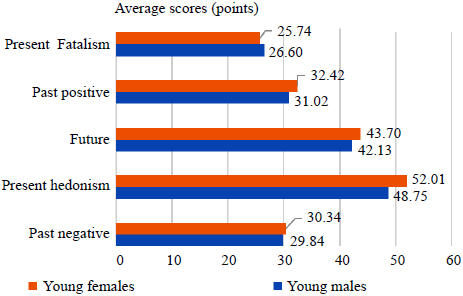
The greatest difference was found in the “fatalistic present” parameter, even though both groups of respondents exhibited levels of this trait within the mid-range. Men are more inclined to view life as predetermined and exhibit fatalistic tendencies, while women are more likely to believe in the possibility of “fixing and changing everything”.
With regard to the assessment of a negative past, respondents of both genders show a moderate level of this indicator, suggesting that certain negative past experiences do not weigh heavily on the present and are viewed in a reflective manner. In contrast, the “positive past” parameter shows a high level of expression among respondents in both groups, reflecting their view of it as a unique resource for shaping their life prospects.
Thus, it can be concluded that, in terms of temporal perspective, both men and women demonstrate a certain prevalence of positive past experiences over negative ones, which can be viewed as a subjective resource. The assessment revealed a balance between future-oriented perspectives and a reflective evaluation of current events. The survey identified factors that, in the respondents’ view, have a significant influence on the formation of their life perspectives. Respondents classified the following as such factors: “social trends”, “vision of the future”, “desire to be in control of one’s own life”, “dreams”, “desire to change one’s situation”, “demands of the times”, and “need to see a future”.
Discussion and Conclusion. Life prospects are linked to an understanding of one’s value- and meaning-based plans and goals, as well as the resources and opportunities available to realize them [13]. Scholars view the existential meaning of life prospects in a person’s subjective reality as an internal anchor that helps maintain a stable personal orientation toward the future amid the turbulence of the external environment [12].
In research into the nature of an individual’s life prospects, the emphasis is placed on the direction of these prospects and their embedding within the temporal span of one’s life journey. The emotional tone of one’s perceptions regarding life prospects plays an important role in the likelihood that events planned by the individual will occur in their own life [14]. In the current sociocultural context, models are presented for organizing an individual’s activity within the space of the past, present, and future, which is reflected in the system of their actions that characterize their unique individuality. The development of reflection on the content of temporal and life perspectives enables the individual to regulate the intensity of their own activity more meaningfully in accordance with their stated motivational intentions.
This is primarily due to the fact that self-reflection fosters an emotional and value-based attitude toward oneself as the agent of shaping and realizing life prospects, along with a corresponding self-assessment of self-efficacy, which in turn affects an individual’s level of psychological well-being and overall quality of life.
Today, having clear and constructive life prospects is a significant factor contributing to an individual’s psychological well-being. A high level of psychological well-being, in turn, is viewed as an indicator of positive functioning. This is because such individuals tend to view themselves as capable of achieving their goals, independent, resilient in the face of environmental turbulence and underlying uncertainty, confident in their abilities, and reliable; they also exhibit fewer internal and external conflicts when encountering obstacles in the pursuit of their life prospects. Individuals with a high level of psychological well-being more often exhibit a positive self-image, experience a sense of self-worth and personal significance, feel that they are important to others, and view themselves as capable of self-actualization in today’s turbulent environment [14].
Conversely, individuals with insufficient psychological well-being are characterized by traits such as internal conflict and self-blame, the tendency to make inadequate and biased assessments of their life prospects, and a negative emotional tone in their activities along the past-present-future continuum [12].
Based on the results of this study, it can be concluded that life perspectives and plans, as well as attitudes toward adapting to the demands of the future, correlate with young people’s conceptions of the role of a vision of the future in achieving success in the contemporary sociocultural context. In cases where an individual’s life prospects are insufficiently developed, passivity may manifest in the pursuit of meaningful life goals, along with doubts about one’s self-efficacy and one’s capacity for transformative action aimed at improving the quality of life in the future. In a rapidly changing world, it is necessary to take into account both at the individual level and at the level of social regulation of behavior the possibility of a certain reconstruction, correction, or transformation of an individual’s life perspectives, which is determined by the nature of the new challenges and priorities they face.
An individual’s life prospects reflect the following interrelated components: the “value-and-meaning,” “emotionalevaluative,” “cognitive,” and “organizational-activity” components; their integration allows for the structuring of the individual’s current activity and the flow of future-oriented actions, thereby ensuring pre-adaptation.
1. Platonova S.I. Phenomenological social theory in the context of the non-classical paradigm of social research. University proceedings. Volga region. Humanities. 2011;20(4):42–49. (In Russ.)
2. Reznik Yu.M. Sociocultural approach as a research methodology. Issues of social theory. 2008;2:305–328. (In Russ.)
3. Rubinstein S.L. Being and consciousness. Man and the world. St. Petersburg: Piter; 2003. 502 p. (In Russ.)
4. Abulkhanova-Slavskaya K.A. Life prospects of the individual. In: Psychology of personality and way of life. Moscow: Prosveshchenie; 2007. 321 p. (In Russ.)
5. Belozerova L.A., Vershinina V.V., Danilov S.V., et al. Socio-cultural Context and Educational Situation of Modern High School Students. Volga Region Pedagogical Search. 2020;34(4):43–53. (In Russ.) https://doi.org/10.33065/2307-1052-2020-4-34-43-53
6. Tolstykh N.N. Development of the Personality’s Temporal Perspective: A Cultural-Historical Approach. Abstract of a Doctor of Psychology Dissertation. Moscow; 2010. 54 p. (In Russ.)
7. Shilova N.P., Vladyko A.K. The modern cultural context of ideas about the future in adolescence. Siberian Journal of Psychology. 2022;86. (In Russ.) https://doi.org/10.17223/17267080/86/6
8. Vologdina P.E., Ippolitova E.A. Phenomenon of vital prospects in psychological science. Forum of Young Scientists. 2018;12–1(28). (In Russ.)
9. Fromm E. To Have or to Be. Moscow: AST; 2023. (In Russ.)
10. Ginzburg M.R. Psychological Content of Personal Self-Determination. Voprosy Psychologii. 1994;3:43–52. (In Russ.)
11. Nurkova V.V., Vasilevskaya K.N. Autobiographical Memory in a Difficult Life Situation: New Phenomena. Voprosy Psychologii. 2003;5:93–102. (In Russ.)
12. Savelyeva V.A., Kornilova T.V. Connections between emotional forecasting and the components of a person’s intellectualpersonal potential. National Psychological Journal. 2026;21(1):94–106. (In Russ.) https://doi.org/10.11621/npj.2026.0108
13. Uvarov E.A. The influence of sense of life purpose on building time perspective by contemporary youth. Tambov University Review. Series: Social sciences. 2017;1(9):66–75. (In Russ.)
14. Shcherbakova T.N., Loseva I.I., Misirov D.N. Identity as a predictor of subjective well-being of an individual in the context of the modern socio-cultural space. The Humanities and Social Sciences. 2025;109–2:77–84. (In Russ.) https://doi.org/10.18522/2070-1403-2025-109-2-77-84
15. Shamionov R.M., Bocharova E.E., Nevsky E.V. The relationship between life Orientations, social identity, and social activity of young people. Russian Psychological Journal. 2021;18(4):91–105. (In Russ.) https://doi.org/10.21702/rpj.2021.4.7
16. Рrzybylsk A.K., Weinstein N. Investigating the Motivational and Psychosocial Dynamics of Dysregulated Gaming: Evidence From a Preregistered Cohort Study. Clinical Psychological Science. 1919;7(6):1257–1265. https://doi.org/10.1177/2167702619859341
17. Scherbakova T., Misirov D.N., Akopyan M.A., Ogannisyan L. The student as a subject of transformative activity in the period of professional training. In: E3S Web of Conferences: 13th International Scientific and Practical Conference on State and Prospects for the Development of Agribusiness, INTERAGROMASH 2020. Rostov-on-Don; 2020;175(18):15013. https://doi.org/10.1051/e3sconf/202017515013
18. Zimbardo F., Boyd J. The time paradox. New psychology of time that will improve your life. St. Petersburg: Rech; 2010. 352 p. (In Russ.)
Shcherbakova Tatyana Nikolaevna, Ph.D (Advanced Doctorate) in Psychology, Professor, Don State Technical University (1, Gagarin Sq., Rostov-on-Don, 344003, Russian Federation)
Loseva Irina Ivanovna, Cand. Sci. (Pedagogical Sciences), Associate Professor, Moscow State Pedagogical University (1/1, Malaya Pirogovskaya St., Moscow, 119991, Russian Federation)
Zhitnaya Inna Viktorovna, Cand. Sci. (Pedagogical Sciences), Southern Federal University (116, Dneprovsky Lane, Rostov-on-Don, 344003, Russian Federation)
Shcherbakova T.N., Loseva I.I., Zhitnaya I.V. Individual’s Life Prospects in the Contemporary Sociocultural Context. Science Almanac of Black Sea Region Countries. 2026;12(3):20-26. https://doi.org/10.23947/2414-1143-2026-12-3-20-26
 Email this article (Login required)
Email the author (Login required)
Email this article (Login required)
Email the author (Login required) 344000, Rostov-on-Don, Gagarin sqr, 1, building 8, office 411.
Tel/fax: +7 (863) 273-86-63
e-mail: science-almanac@mail.ru