Contents
Scroll to:
https://doi.org/10.23947/2414-1143-2026-12-2-29-33
Scroll to:
Introduction. This study is devoted to the peculiarities of global digital signs` functioning in the culture of young people in the Black Sea region (the Krasnodar Territory and the Republic of Crimea) in conditions of glocalization. The interaction of global and local cultural forms through the prism of glocalization and the high activity of young people in the digital environment made it possible to identify features of global digital signs` functioning in the semiotic culture of young people in the Krasnodar Territory and the Republic of Crimea. Young people in the Black Sea region are actively adapting global digital signs to local cultural contexts, forming unique semiotic patterns that reflect localization processes in the digital environment.
Materials and Methods. Semiotic approach and empirical data on the digital activity of young people were used (Rosstat statistics, data from Levada-сenter, regional research). The methodology combines analysis of the digital environment, glocalization processes and identification of ways to adapt global signs to local cultural contexts.
Results. The results of the study show that the digital environment in the Black Sea region functions not just as a set of technologies but as a space for the formation and transformation of sign systems that reflect social and cultural changes. The analysis of the digital activity of young people in the Krasnodar Territory and Crimea revealed differences in media preferences and communication patterns, which forms unique local codes and symbolic practices. The application of glocalization and semiotic approach allows linking global processes with local cultural practices, revealing the relationship between digital technologies, youth culture and global semiotic dynamics.
Discussion and Conclusion. The study shows that the digital environment of the youth of the Black Sea region forms unique local interpretations of global signs, influencing value guidelines, behavioral models and regional identity. The results of the work open up prospects for further study of the processes of glocalization and transformation of cultural practices of young people in the context of digital communication.
Petrova Yu.A. Global Digital Signs and Semiotic Culture of Youth in Black Sea Region in Conditions of Glocalization. Science Almanac of Black Sea Region Countries. 2026;12(2):29-33. https://doi.org/10.23947/2414-1143-2026-12-2-29-33
Introduction. In the context of globalization, digital communication forms new sign systems of youth culture. It is especially interesting to trace how global symbols are transformed in the regional context of the Black Sea. Semiotics is not just about studying materials regardless of human involvement. It deals with meaning, and whenever meaning comes into play, reason is involved [1, p. 13]. According to this point of view, the identity of everything that exists in the world is understood from a human point of view. Signs are formed and perceived in consciousness, and the world consists of things and concepts that people see, know or understand by them.
From this point of view, the world is a code consisting of signs and rules. Signs are all “things” and “concepts” that people know or use. Rules explain functions, position, and meaning of signs, and determine their relationship to other signs. This part of the study is aimed at identifying changes related to globalization, based on the wording “peace is a code”. It does not consider the causes and tools of globalization, such as the growth of international trade or technological innovation but the final results of these processes.
In the general scientific sense, semiotics includes “language units of value-semantic categories of culture”, i. e. a system of significant signs of the youth subculture [2, p. 160]. The consideration is carried out on the example of the language of digital culture. Traits, skills and behavior of young people are determined based on cognitive processes and sign-symbolic systems. The sign system has become a tool that allows young people to function both online and offline.
The relevance of the study is determined by the fact that the Black Sea region is characterized by high digital involvement of young people, intensive migration and transformation of local cultural practices under the influence of global digital signs.
The purpose of the study is to identify features of global digital signs` functioning in the semiotic culture of young people in the Krasnodar Territory and the Republic of Crimea in conditions of glocalization. The youth of the Black Sea region of the Russian Federation is considered as an object of the study. The subject of the study is sign systems and communicative practices of the digital environment that form the semiotic culture of youth.
The scientific novelty of the study is to consider the digital communication of the youth of the region through the prism of global semiotics and analyze the relationship between global information processes and local cultural environment.
Materials and Methods. The study of youth culture allows us to consider the digital environment not just as a set of technologies but as a space in which sign systems are formed and transformed. Youth actively interact with internet memes, messaging formats, videos, and face-to-face communication, creating and interpreting shared texts of communicative practice, reflecting both everyday exchanges and cultural patterns of digital interaction.
The application of semiotics requires an appeal to cognitive and social aspects, since signs exist not only in material form but also as constructions in the minds of communication participants. In the study, this manifests itself through analyzing how young people perceive, use and transform digital symbols in their daily practice, and through identifying patterns in their cognitive and behavioral patterns.
The analysis includes the study of the frequency of the Internet use, the activity in social networks and instant messengers, as well as the involvement of young people in multimedia and interactive formats. The deterministic aspect of the study takes into account the conditions created by technological environments and their impact on the communication behavior of young people. The analysis is carried out in the context of local cultural features of the Krasnodar Territory and the Republic of Crimea, which makes it possible to identify unique patterns of digital symbols`s use and sensemaking practices.
Thus, the research methodology combines semiotic analysis with reliance on the empirical Russian data and the study of the digital environment. Data on the demographic structure of the region are provided by the Federal State Statistics Service [3], and studies of digital activity and media preferences are based on regional empirical studies [4, 5]. This creates a comprehensive understanding of how global signs adapt to local conditions and how young people use digital technologies to express their individual and regional identities.
Results. This work is aimed at studying globalization in the research of youth culture, which makes it possible to consider the digital environment not just as a set of technologies but as a space in which sign systems are formed and transformed, which makes it possible to better study social and cultural transformations in the Black Sea region.
The figure shows digital activity and media preferences of youth in the Krasnodar Territory and the Republic of Crimea according to Rosstat [3] and Levada-center [6].
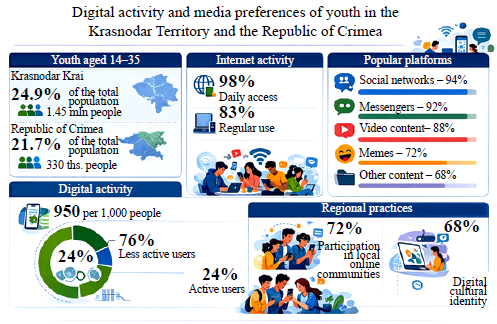
This figure was created by the author using AI. The image reflects Internet culture as an integrated part of modern culture, where interfaces, algorithms and platforms become carriers of diversity, inclusiveness and general accessibility in the context of local cultural features of the Black Sea region territories. Analysis of the data showed that the youth of Krasnodar mainly use social networks to exchange multimedia content, while the youth of Crimea demonstrate more active involvement in online communities and gaming platforms, forming unique patterns of digital communication.
Semiotic analysis shows that the youth of Krasnodar and Crimea actively interpret and integrate global digital signs into everyday communication, forming their own local codes and symbolic patterns. The processes of localized globalization in the study are defined as consisting of “globalization in terms of form and localization in terms of content” [7]. Our study does not aim to summarize the main global processes. Globalization in terms of form is substantially simpler than glocalization in terms of content. For an object or concept to be glocalized in terms of form, it is necessary that they become visible to people around the world. Then people might want to import, produce or use them. Seeing other parts of the world and importing things and concepts are two characteristics of our global world today. Changes caused by globalization are reflected at cognitive and behavioral levels, affecting the perception and use of signs, which are regulated by rules in social and cultural practice [8], [9].
Therefore, glocalization and semiotic approach allow the integration of digital technology analysis and social practices, revealing the interconnection between sign systems, youth culture and global processes through the lens of the digital world.
Discussion and Conclusion. The nature of the world in terms of semiotics is very different from the nature of the world of physics or chemistry. When the world is defined as a sequence of signs, both objects and concepts should be taken into account. The signs that form the world are both observable symbols and/or signs and symbols and/or signs formed in the mind. Changes in the world defined in terms of intellectual audience can be both cognitive and/or behavioral. In other words, existing objects and concepts in society that can be studied from two perspectives.
Cognitive level is related to what people think, know or understand. Based on the above, the world can be considered as a complex combination of perceptions and behaviors regarding various objects and concepts. Therefore, any changes taking place in the world (including changes caused by globalization) will necessarily be associated with changes in these factors. Internet culture is described as an internal part of culture connected with search engine technologies or as an interface part with its characteristic diversity [10]. In order to analyze the problem, which was identified by a random audience that formed on a voluntary basis through the Internet, which provided both data for research and became a tool for quantitative analysis based on a social survey. The deterministic approach of the study of youth culture in the digital environment made it possible to omit the conditions, both created by technology and through which they work.
According to this point of view, changes in any part of the world can be caused by the following rule changes associated with these signs. The way we use things, the way we think about different concepts, and the way things and concepts are understood or perceived in connection with other signs, are constantly changing. Every person on the planet shares cultural products with symbols recognizable everywhere. The speed and intensity of the global network, interconnection and integration over the past twenty years has sparked a major debate about cultural and social implications. The current trend of globalization goes much further than just the relationship between national economies and global markets. Indeed, globalization of production, largely through inter-firm trade, is widespread and deeply entrenched. In addition, this process at its current stage is both cultural and semiotic, which has important social aspects for further study of this issue.
The theoretical approach combines signs` analysis with the study of social and cultural practices of young people. This allows us to show how digital technologies form communication patterns, influence value orientations and behavior patterns, and contribute to the development of regional identity. Internet culture is seen as an integrated part of modern culture, where interfaces, algorithms, and platforms become carriers of diversity, inclusion, and general accessibility.
The article includes empirical data and literature analysis on the topic of research on youth practices, globalization, glocalization, digital engagement and media preferences of young people. This study is aimed at studying the semiotic significance of globalization in the context of globalization, where digital communication forms new sign systems of youth Internet culture. Global symbols, that are transformed in the regional context of the Black Sea, in the Krasnodar Territory and the Republic of Crimea, are of particular interest.
Models of digital communication and media preferences reflect precisely those features of global signs` functioning, which were the purpose of the study, opening up opportunities for further study of glocalization, transformation of values and methods of interpreting global digital signs in the local context using the example of the Black Sea regions.
1. Lucy N. Beyond Semiotics: Text, Culture and Technology. London: Continuum; 2001. 167 p.
2. Petrova Yu.A. Features of the linguistic and cultural approach to the study of the values of the youth subculture. Economic and humanitarian studies of the regions. 2012;3:159.165. (In Russ.)
3. Youth of the Krasnodar Territory, data on the 1st of January, 2025. Rosstat. (In Russ.) URL: https://23.rosstat.gov.ru/storage/mediabank/„D„u„~„Ž%20„}„€„|„€„t„u„w„y%2816%29.pdf (accessed: 10.03.2026).
4. Mirontseva S.A., Olga A. Borisko O.A., Bashmakov I.S. Internet Technologies of Regional Youth Identity Formation in the Krasnodar Krai. Society: politics, economics, law. 2024;1:29.37. (In Russ.)
5. Chigrin V.A., Zotkin A.A., Gorodetskaya E.G., Uzunov V.V. Dynamics and structure of youth preferences in the information space of the Republic of Crimea. Vestnik instituta sotziologii. 2022;13(2):184.199. (In Russ.) https://doi.org/10.19181/vis.2022.13.2.801
6. Use of the internet, social networks, messengers, and other online services: March 2025. Levada-center. 2025. URL: https://www.levada.ru/2025/04/24/polzovanie-internetom-sotsialnymi-setyami-messendzherami-iskusstvennymintellektom-i-drugimi-onlajn-servisami-mart-2025/ (accessed: 14.03.2026).
7. Beyer „Q. Religion and Globalization. London: SAGE Publications Ltd; 1994. 250 p.
8. Burgin V. Photographic Practice and Art Theory. London: Macmillan; 1982. P. 39.83.
9. Voloshinov V.N. Marxism and the philosophy of language. Moscow: Labirint; 1993. 196 p. (In Russ.)
10. Hermeking M. Culture and Internet Consumption: Contributions from Cross Cultural Marketing and Advertising Research. Journal of Computer Mediated Communication. 2006;11(1):375.392. https://doi.org/10.1111/j.1083-6101.2006.tb00315.x
Petrova Yulia Andreevna, Cand. Sci. (Philosophy), Associate Professor, “Foreign Languages for Economic Specialties”, Rostov State Economic University, (69, Bolshaya Sadovaya St., Rostov-on-Don, 344002, Russian Fediration)
Petrova Yu.A. Global Digital Signs and Semiotic Culture of Youth in Black Sea Region in Conditions of Glocalization. Science Almanac of Black Sea Region Countries. 2026;12(2):29-33. https://doi.org/10.23947/2414-1143-2026-12-2-29-33
 Email this article (Login required)
Email the author (Login required)
Email this article (Login required)
Email the author (Login required) 344000, Rostov-on-Don, Gagarin sqr, 1, building 8, office 411.
Tel/fax: +7 (863) 273-86-63
e-mail: science-almanac@mail.ru